RING1 Monoclonal Antibody (8E8A2), Invitrogen™
Manufacturer: Thermo Scientific
Select a Size
| Pack Size | SKU | Availability | Price |
|---|---|---|---|
| Each of 1 | PIMA531894-Each-of-1 | In Stock | ₹ 49,350.50 |
PIMA531894 - Each of 1
In Stock
Quantity
1
Base Price: ₹ 49,350.50
GST (18%): ₹ 8,883.09
Total Price: ₹ 58,233.59
Antigen
RING1
Classification
Monoclonal
Concentration
1 mg/mL
Formulation
PBS with 0.05% sodium azide
Gene Accession No.
Q06587
Gene Symbols
RING1
Immunogen
Purified recombinant fragment of human Ring1 (AA: 79-263) expressed in E. coli.
Quantity
100μL
Primary or Secondary
Primary
Target Species
Human
Product Type
Antibody
Isotype
IgG1
Applications
ELISA, Immunocytochemistry, Western Blot
Clone
8E8A2
Conjugate
Unconjugated
Gene
RING1
Gene Alias
E3 ubiquitin-protein ligase RING1; Polycomb complex protein RING1; really interesting new gene 1 protein; RING finger protein 1; RING1; Ring1A; RING-type E3 ubiquitin transferase RING1; Rnf1; Transcription repressor Ring1A
Host Species
Mouse
Purification Method
Protein G
Regulatory Status
RUO
Gene ID (Entrez)
6015
Content And Storage
Store at 4°C short term. For long term storage, store at -20°C, avoiding freeze/thaw cycles.
Form
Liquid
Related Products

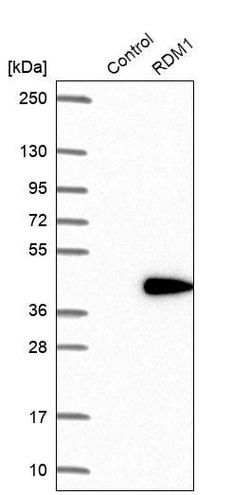

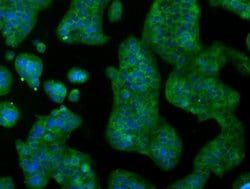
Description
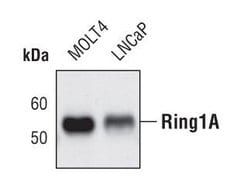
- MA5-31894 has been tested in indirect ELISA
- This gene belongs to the RING finger family, members of which encode proteins characterized by a RING domain, a zinc-binding motif related to the zinc finger domain
- The gene product can bind DNA and can act as a transcriptional repressor
- It is associated with the multimeric polycomb group protein complex
- The gene product interacts with the polycomb group proteins BMI1, EDR1, and CBX4, and colocalizes with these proteins in large nuclear domains
- It interacts with the CBX4 protein via its glycine-rich C-terminal domain
- The gene maps to the HLA class II region, where it is contiguous with the RING finger genes FABGL and HKE4.