PIMA531909
SSH1 Monoclonal Antibody (6C11G9), Invitrogen™
Manufacturer: Thermo Scientific
Select a Size
| Pack Size | SKU | Availability | Price |
|---|---|---|---|
| Each of 1 | PIMA531909-Each-of-1 | In Stock | ₹ 49,350.50 |
PIMA531909 - Each of 1
In Stock
Quantity
1
Base Price: ₹ 49,350.50
GST (18%): ₹ 8,883.09
Total Price: ₹ 58,233.59
Antigen
SSH1
Classification
Monoclonal
Concentration
1 mg/mL
Formulation
PBS with 0.05% sodium azide
Gene Accession No.
Q8WYL5
Gene Symbols
SSH1
Immunogen
Synthesized peptide fragment of human SLINGSHOT-1L (AA: 1032-1044 ) expressed in E. coli.
Quantity
100 μL
Primary or Secondary
Primary
Target Species
Human
Product Type
Antibody
Isotype
IgG1
Applications
ELISA, Flow Cytometry, Immunohistochemistry (Paraffin)
Clone
6C11G9
Conjugate
Unconjugated
Gene
SSH1
Gene Alias
hSSH-1L; KIAA1298; Protein phosphatase Slingshot homolog 1; slingshot homolog 1; slingshot protein phosphatase 1; SSH1; SSH1L; SSH-1L; SSH-like protein 1
Host Species
Mouse
Purification Method
Protein G
Regulatory Status
RUO
Gene ID (Entrez)
54434
Content And Storage
Store at 4°C short term. For long term storage, store at -20°C, avoiding freeze/thaw cycles.
Form
Liquid
Related Products


Description
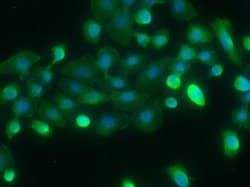
- MA5-31909 has been tested in indirect ELISA
- This gene encodes a member of the SWI/SNF family, whose members have helicase and ATPase activities and are thought to regulate transcription of certain genes by altering the chromatin structure around those genes
- The encoded protein is part of the large ATP-dependent chromatin remodeling complex SNF/SWI, which is required for transcriptional activation of genes normally repressed by chromatin
- It possesses at least two conserved domains that could be important for its function
- First, it has a DNA-binding domain that can specifically bind an AT-rich DNA sequence known to be recognized by a SNF/SWI complex at the beta-globin locus
- Second, the C-terminus of the protein can stimulate glucocorticoid receptor-dependent transcriptional activation
- It is thought that the protein encoded by this gene confers specificity to the SNF/SWI complex and may recruit the complex to its targets through either protein-DNA or protein-protein interactions
- Two transcript variants encoding different isoforms have been found for this gene.