Phospho-HSF1 (Ser326) Recombinant Rabbit Monoclonal Antibody (SU31-03), Invitrogen™
Manufacturer: Thermo Scientific
Select a Size
| Pack Size | SKU | Availability | Price |
|---|---|---|---|
| Each of 1 | PIMA532105-Each-of-1 | In Stock | ₹ 46,413.50 |
PIMA532105 - Each of 1
In Stock
Quantity
1
Base Price: ₹ 46,413.50
GST (18%): ₹ 8,354.43
Total Price: ₹ 54,767.93
Antigen
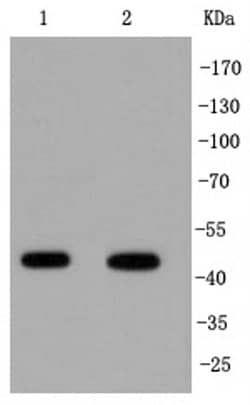
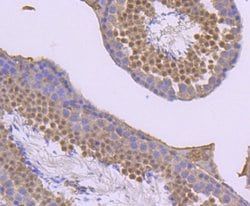
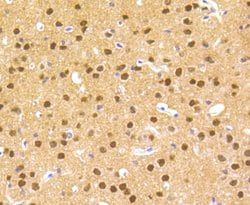
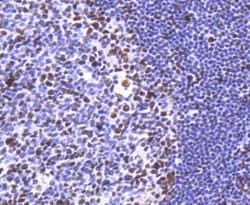
Phospho-HSF1 (Ser326)
Classification
Monoclonal
Concentration
1 mg/mL
Formulation
TBS with 0.05% BSA, 40% Glycerol and 0.05% sodium azide, pH 7.4
Gene Accession No.
Q00613
Gene Symbols
Hsf1
Immunogen
Synthetic phospho-peptide corresponding to residues surrounding Ser326 of Human HSF1 aa 301-350
Quantity
100 μL
Primary or Secondary
Primary
Target Species
Human
Product Type
Antibody
Isotype
IgG
Applications
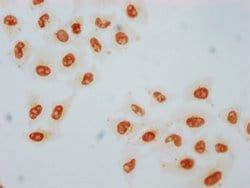
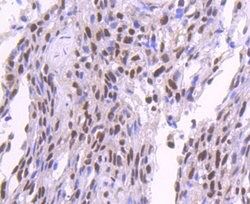
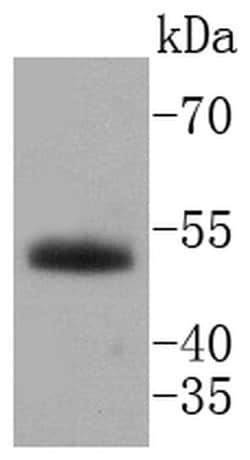
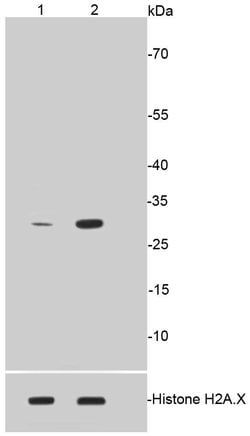
Flow Cytometry, Immunocytochemistry, Immunohistochemistry, Western Blot, Western Blot
Clone
SU31-03
Conjugate
Unconjugated
Gene
Hsf1
Gene Alias
AA960185, heat shock factor 1, heat shock factor 2, Heat shock factor protein 1, Heat shock transcription factor 1, heat shock transcription factor 1 alpha isoform, heat shock transcription factor 1 beta isoform, heat shock transcription factor 1 gammaalpha isoform, heat shock transcription factor 1 gammabeta isoform, HSF, HSF 1, Hsf1, Hsf1alpha, Hsf1beta, Hsf1gammaalpha, Hsf1gammabeta, HSTF 1, HSTF1
Host Species
Rabbit
Purification Method
Protein A
Regulatory Status
RUO
Gene ID (Entrez)
3297
Content And Storage
Store at 4°C short term. For long term storage, store at -20°C, avoiding freeze/thaw cycles.
Form
Liquid
Related Products
Description
- Recombinant rabbit monoclonal antibodies are produced using in vitro expression systems
- The expression systems are developed by cloning in the specific antibody DNA sequences from immunoreactive rabbits
- Then, individual clones are screened to select the best candidates for production
- The advantages of using recombinant rabbit monoclonal antibodies include: better specificity and sensitivity, lot-to-lot consistency, animal origin-free formulations, and broader immunoreactivity to diverse targets due to larger rabbit immune repertoire
- All organisms respond to elevated temperatures and a variety of environmental stresses by rapid synthesis of heat shock RNAs and proteins
- The regulation of heat shock gene transcription is mediated by the transcriptional activator, heat shock factor (HSF), which binds to heat shock response elements (HSEs)
- These HSEs are found as three repeats of a 5-nucleotide {nGAAn} module, arranged in alternating orientation and present upstream of all heat shock genes
- The HSEs are highly conserved among species yet HSF purified from yeast, Drosophila and human have different molecular weights and the proteins do not show significant immunological cross reaction
- Two HSFs have been identified in human cells, HSF1 and HSF2, which bind to the same HSEs and have 38% sequence identity
- These factors are activated by distinct stimuli, HSF1 is responsive to classical stress signals such as heat, heavy metals and oxidative reagents, whereas HSF2 is activated during hemin-mediated differentiation of human erythroleukemia cells
- HSF1 exists constitutively in the cytoplasm and the nucleus of unstressed cells as a monomer which lacks DNA binding activity
- Through an unknown signal generated during stress, HSF1 becomes activated to a nuclear localized, trimeric state which binds to DNA
- The phosphorylation of HSF1 is necessary for maximal transcription of heat shock genes.