PIMA536071
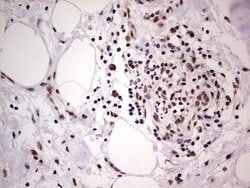
MSH3 Recombinant Rabbit Monoclonal Antibody (RM405), Invitrogen™
Manufacturer: Thermo Scientific
Select a Size
| Pack Size | SKU | Availability | Price |
|---|---|---|---|
| Each of 1 | PIMA536071-Each-of-1 | In Stock | ₹ 43,921.50 |
PIMA536071 - Each of 1
In Stock
Quantity
1
Base Price: ₹ 43,921.50
GST (18%): ₹ 7,905.87
Total Price: ₹ 51,827.37
Antigen
MSH3
Classification
Monoclonal
Concentration
0.04 mg/mL
Formulation
PBS with 1% BSA, 50% glycerol and 0.09% sodium azide
Gene Accession No.
P20585
Gene Symbols
MSH3
Immunogen
A peptide corresponding to residues near the N-terminus of human MSH3
Quantity
100 μL
Primary or Secondary
Primary
Target Species
Human
Product Type
Antibody
Isotype
IgG
Applications
Immunohistochemistry (Paraffin), Western Blot
Clone
RM405
Conjugate
Unconjugated
Gene
MSH3
Gene Alias
D13Em1; Divergent upstream protein; DNA mismatch repair protein Msh3; DUC1; DUG; DUP; hMSH3; Mismatch repair protein 1; MRP1; MSH3; mutS homolog 3; mutS homolog 3 (E. coli); protein repair-1; Protein repair-3; REP-1; Rep3; Rep-3
Host Species
Rabbit
Purification Method
Protein A
Regulatory Status
RUO
Gene ID (Entrez)
4437
Content And Storage
-20°C
Form
Liquid
Related Products



Description
- Component of the post-replicative DNA mismatch repair system (MMR)
- Heterodimerizes with MSH2 to form MutS beta which binds to DNA mismatches thereby initiating DNA repair
- When bound, the MutS beta heterodimer bends the DNA helix and shields approximately 20 base pairs
- MutS beta recognizes large insertion-deletion loops (IDL) up to 13 nucleotides long
- After mismatch binding, forms a ternary complex with the MutL alpha heterodimer, which is thought to be responsible for directing the downstream MMR events, including strand discrimination, excision, and resynthesis.