Paxillin Chimeric Recombinant Rabbit Monoclonal Antibody (LD2 sAB), Invitrogen™
Manufacturer: Thermo Scientific
Select a Size
| Pack Size | SKU | Availability | Price |
|---|---|---|---|
| Each of 1 | PIMA547944-Each-of-1 | In Stock | ₹ 46,769.50 |
PIMA547944 - Each of 1
In Stock
Quantity
1
Base Price: ₹ 46,769.50
GST (18%): ₹ 8,418.51
Total Price: ₹ 55,188.01
Antigen
Paxillin Chimeric
Classification
Recombinant Monoclonal
Concentration
1 mg/mL
Formulation
PBS with 0.02% ProClin 300
Gene Accession No.
P49023
Gene Symbols
PXN
Immunogen
Peptide corresponding to paxillin-LD2 motif (residues 141-156) fused to MBP, peptide sequence: NLSELDRLLLELNAVQHNP.
Quantity
200 μg
Primary or Secondary
Primary
Target Species
Human
Form
Liquid
Applications
ELISA, Western Blot
Clone
LD2 sAB
Conjugate
Unconjugated
Gene
PXN
Gene Alias
adaptor protein; AW108311; AW123232; FLJ16691; hCG_1778014; I79_001229; myocardial ischemic preconditioning associated protein 7; Pax; PAX-1; PAXI; Paxillin; paxillin a; paxillin alpha; pxn; pxna; testicular tissue protein Li 134; TGFB1I1; transforming growth factor beta 1 induced transcript 1; wu:fw71f12
Host Species
Rabbit
Purification Method
Affinity chromatography
Regulatory Status
RUO
Gene ID (Entrez)
5829
Content And Storage
Store at 4°C short term. For long term storage, store at -20°C, avoiding freeze/thaw cycles.
Isotype
IgG κ
Related Products


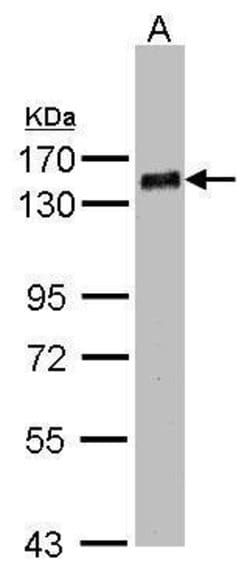

Description
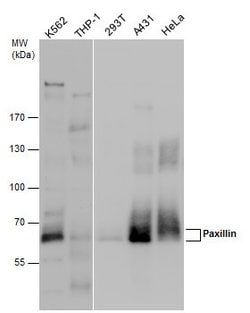
- Specificity: The antibody binds specifically to the LD-2 motif of human paxillin with a Kd of 24 nM
- Paxillin is a focal adhesion protein and a substrate for several tyrosine kinases such as src, FAK, and p210BRC/ABL
- The tyrosine phosphorylation of paxillin is affected by conditions that change cell-cell adhesion
- Paxillin associates tightly with FAK and Crk through its SH2 domain
- This interaction is independent of the extracellular matrix
- Although paxillin was initially discovered in fibroblasts, its phosphorylation may also be important during neurite extension during differentiation.