MTNR1B Polyclonal Antibody, Invitrogen™
Manufacturer: Thermo Scientific
Select a Size
| Pack Size | SKU | Availability | Price |
|---|---|---|---|
| Each of 1 | PIPA132563-Each-of-1 | In Stock | ₹ 49,083.50 |
PIPA132563 - Each of 1
In Stock
Quantity
1
Base Price: ₹ 49,083.50
GST (18%): ₹ 8,835.03
Total Price: ₹ 57,918.53
Antigen
MTNR1B
Classification
Polyclonal
Conjugate
Unconjugated
Gene
MTNR1B
Gene Alias
FGQTL2; LOW QUALITY PROTEIN: melatonin receptor type 1B; Mel1b; mel1b melatonin receptor; Mel-1b melatonin receptor; mel1b receptor; mel-1B-R; Mel1b-r; melatonin receptor 1B; melatonin receptor 1B variant b; melatonin receptor MEL1B; melatonin receptor type 1B; Mt2; MT2 melatonin receptor; MTNR1B; putative melatonin receptor 1B
Host Species
Rabbit
Purification Method
Antigen affinity chromatography
Regulatory Status
RUO
Gene ID (Entrez)
4544
Content And Storage
Store at 4°C short term. For long term storage, store at -20°C, avoiding freeze/thaw cycles.
Form
Liquid
Applications
Immunohistochemistry (Paraffin)
Concentration
1 mg/mL
Formulation
PBS with 0.1% sodium azide
Gene Accession No.
P49286
Gene Symbols
MTNR1B
Immunogen
Synthetic 16 amino acid peptide from 3rd cytoplasmic domain of human MT2
Quantity
25 μg
Primary or Secondary
Primary
Target Species
Human
Product Type
Antibody
Isotype
IgG
Related Products

Description
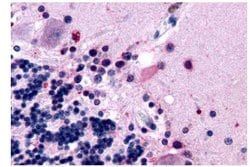
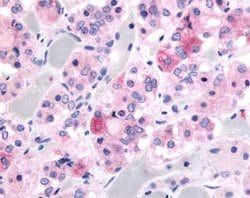
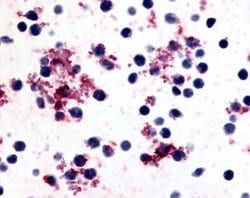
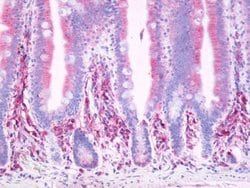
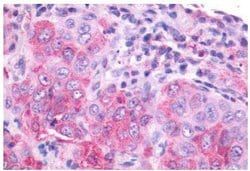
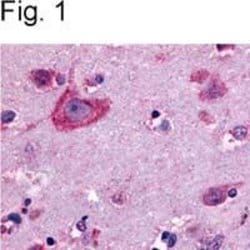
- Description PA1-32563 detects Melatonin Receptor Type 1B (MT2) from human samples
- This gene encodes one of two high affinity forms of a receptor for melatonin, the primary hormone secreted by the pineal gland
- This gene product is an integral membrane protein that is a G-protein coupled, 7-transmembrane receptor
- It is found primarily in the retina and brain although this detection requires RT-PCR
- It is thought to participate in light-dependent functions in the retina and may be involved in the neurobiological effects of melatonin.