USP3 Polyclonal Antibody, Invitrogen™
Manufacturer: Thermo Scientific
Select a Size
| Pack Size | SKU | Availability | Price |
|---|---|---|---|
| Each of 1 | PIPA5104198-Each-of-1 | In Stock | ₹ 46,502.50 |
PIPA5104198 - Each of 1
In Stock
Quantity
1
Base Price: ₹ 46,502.50
GST (18%): ₹ 8,370.45
Total Price: ₹ 54,872.95
Antigen
USP3
Classification
Polyclonal
Conjugate
Unconjugated
Gene
USP3
Gene Alias
AA409661; BC017156; Deubiquitinating enzyme 3; SIH003; Ubiquitin carboxyl-terminal hydrolase 3; ubiquitin specific peptidase 3; ubiquitin specific protease 3; ubiquitin thioesterase 3; ubiquitin thiolesterase 3; ubiquitin-specific-processing protease 3; UBP; Usp3
Host Species
Rabbit
Purification Method
Affinity chromatography
Regulatory Status
RUO
Gene ID (Entrez)
235441, 363084, 9960
Content And Storage
-20°C
Form
Liquid
Applications
Immunohistochemistry (Paraffin), Western Blot
Concentration
1 mg/mL
Formulation
PBS with 50% glycerol and 0.02% sodium azide; pH 7.4
Gene Accession No.
Q91W36, Q9Y6I4
Gene Symbols
USP3
Immunogen
A synthesized peptide derived from human USP3(Accession Q9Y6I4), corresponding to amino acid residues M1-N35.
Quantity
100 μL
Primary or Secondary
Primary
Target Species
Human, Mouse, Rat
Product Type
Antibody
Isotype
IgG
Related Products

Description
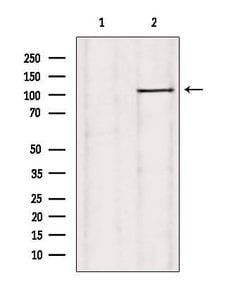
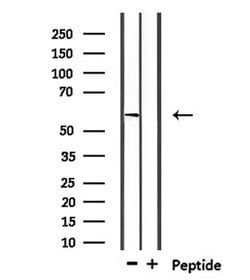
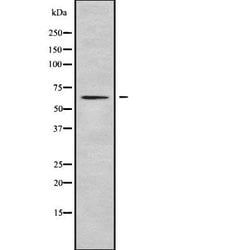
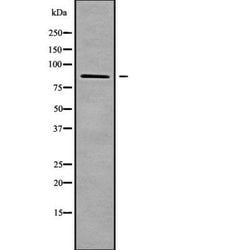
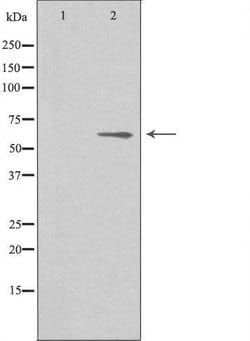
- Antibody detects endogenous levels of total USP3
- Modification of target proteins by ubiquitin participates in a wide array of biological functions
- Proteins destined for degradation or processing via the 26 S proteasome are coupled to multiple copies of ubiquitin
- However, attachment of ubiquitin or ubiquitin-related molecules may also result in changes in subcellular distribution or modification of protein activity
- An additional level of ubiquitin regulation, deubiquitination, is catalyzed by proteases called deubiquitinating enzymes, which fall into four distinct families
- Ubiquitin C-terminal hydrolases, ubiquitin-specific processing proteases (USPs),1 OTU-domain ubiquitin-aldehyde-binding proteins, and Jab1/Pad1/MPN-domain-containing metallo-enzymes
- Among these four families, USPs represent the most widespread and represented deubiquitinating enzymes across evolution
- USPs tend to release ubiquitin from a conjugated protein
- They display similar catalytic domains containing conserved Cys and His boxes but divergent N-terminal and occasionally C-terminal extensions, which are thought to function in substrate recognition, subcellular localization, and protein-protein interactions.