MUC13 Polyclonal Antibody, Invitrogen™
Manufacturer: Thermo Scientific
Select a Size
| Pack Size | SKU | Availability | Price |
|---|---|---|---|
| Each of 1 | PIPA5104505-Each-of-1 | In Stock | ₹ 46,858.50 |
PIPA5104505 - Each of 1
In Stock
Quantity
1
Base Price: ₹ 46,858.50
GST (18%): ₹ 8,434.53
Total Price: ₹ 55,293.03
Antigen
MUC13
Classification
Polyclonal
Conjugate
Unconjugated
Gene
MUC13
Gene Alias
114/A10; 14/A10; AI159736; Cell surface antigen 114/A10; down-regulated in colon cancer 1; DRCC1; Lrrp; Ly64; Lymphocyte antigen 64; Muc-123; MUC13; MUC-13; mucin 13; mucin 13, cell surface associated; mucin 13, epithelial transmembrane; mucin-13; NJ-1; RECC; UNQ6194/PRO20221
Host Species
Rabbit
Purification Method
Affinity chromatography
Regulatory Status
RUO
Gene ID (Entrez)
17063, 207126, 56667
Content And Storage
-20°C
Form
Liquid
Applications
Immunocytochemistry, Immunohistochemistry (Paraffin), Western Blot
Concentration
1 mg/mL
Formulation
PBS with 50% glycerol and 0.02% sodium azide; pH 7.4
Gene Accession No.
P19467, P97881, Q9H3R2
Gene Symbols
MUC13
Immunogen
A synthesized peptide derived from human MUC13(Accession Q9H3R2), corresponding to amino acid residues T424-F474.
Quantity
100 μL
Primary or Secondary
Primary
Target Species
Human, Mouse, Rat
Product Type
Antibody
Isotype
IgG
Related Products




Description
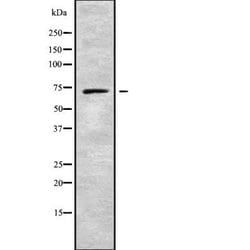
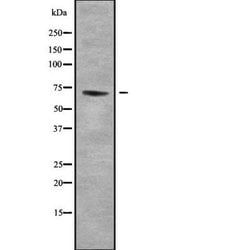
- Antibody detects endogenous levels of total MUC13
- Mucin 13, epithelial transmembrane
- SEA is an extracellular domain associated with O-glycosylation
- Proteins found to contain SEA-modules include, agrin, enterokinase, 63 kDa sea urchin (Strongylocentrotus purpuratus) sperm protein, perlecan (heparan sulphate proteoglycan core, mucin 1 and the cell surface antigen, 114/A10, and two functionally uncharacterised, probably extracellular, Caenorhabditis elegans proteins
- Despite the functional diversity of these adhesive proteins, a common denominator seems to be their existence in heavily glycosylated environments
- In addition, the better characterised proteins all contain O-glycosidic-linked carbohydrates such as heparan sulphate that contribute considerably to their molecular masses
- The common module might regulate or assist binding to neighbouring carbohydrate moieties
- Enterokinase, the initiator of intestinal digestion, is a mosaic protease composed of a distinctive assortment of domains.