NUSAP1 Polyclonal Antibody, Invitrogen™
Manufacturer: Thermo Scientific
Select a Size
| Pack Size | SKU | Availability | Price |
|---|---|---|---|
| Each of 1 | PIPA5106697-Each-of-1 | In Stock | ₹ 46,502.50 |
PIPA5106697 - Each of 1
In Stock
Quantity
1
Base Price: ₹ 46,502.50
GST (18%): ₹ 8,370.45
Total Price: ₹ 54,872.95
Antigen
NUSAP1
Classification
Polyclonal
Conjugate
Unconjugated
Gene
NUSAP1
Gene Alias
2610201A12Rik; AI481307; ankt; AW547774; BB165529; BM037; BM-037; fb76a01; fi37a11; hypothetical protein; LNP; nucleolar and spindle associated protein 1; nucleolar and spindle-associated protein 1; nucleolar protein ANKT; NuSAP; NUSAP1; PRO0310; PRO0310p1; Q0310; SAPL; sb:cb490; Unknown (protein for IMAGE:7053642); Unknown (protein for MGC:134490); wu:fb76a01; wu:fi37a11; YF-9
Host Species
Rabbit
Purification Method
Affinity chromatography
Regulatory Status
RUO
Gene ID (Entrez)
108907, 51203
Content And Storage
-20°C
Form
Liquid
Applications
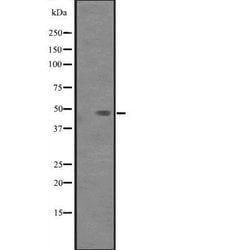
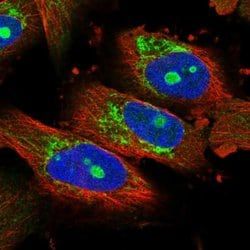
Immunocytochemistry, Immunohistochemistry (Paraffin), Western Blot
Concentration
1 mg/mL
Formulation
PBS with 50% glycerol and 0.02% sodium azide; pH 7.4
Gene Accession No.
Q9BXS6, Q9ERH4
Gene Symbols
NUSAP1
Immunogen
A synthesized peptide derived from human NUSAP1(Accession Q9BXS6), corresponding to amino acid residues V351-K401.
Quantity
100 μL
Primary or Secondary
Primary
Target Species
Human, Mouse
Product Type
Antibody
Isotype
IgG
Related Products

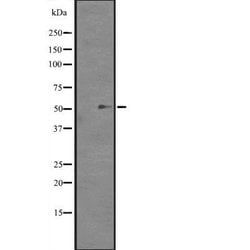
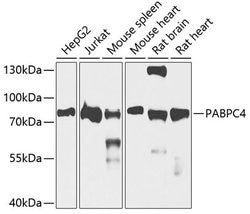
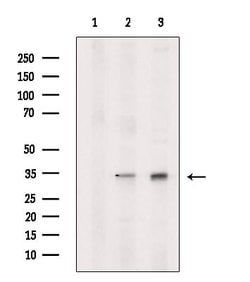
Description
- Antibody detects endogenous levels of total NUSAP1
- Ubiquitin: exists either covalently attached to another protein, or free (unanchored)
- When covalently bound, it is conjugated to target proteins via an isopeptide bond either as a monomer (monoubiquitin), a polymer linked via different Lys residues of the ubiquitin (polyubiquitin chains) or a linear polymer linked via the initiator Met of the ubiquitin (linear polyubiquitin chains)
- Polyubiquitin chains, when attached to a target protein, have different functions depending on the Lys residue of the ubiquitin that is linked: Lys-6-linked may be involved in DNA repair; Lys-11-linked is involved in ERAD (endoplasmic reticulum-associated degradation) and in cell-cycle regulation; Lys-29-linked is involved in lysosomal degradation; Lys-33-linked is involved in kinase modification; Lys-48-linked is involved in protein degradation via the proteasome; Lys-63-linked is involved in endocytosis, DNA-damage responses as well as in signaling processes leading to activation of the transcription factor NF-kappa-B
- Linear polymer chains formed via attachment by the initiator Met lead to cell signaling
- Ubiquitin is usually conjugated to Lys residues of target proteins, however, in rare cases, conjugation to Cys or Ser residues has been observed
- When polyubiquitin is free (unanchored-polyubiquitin), it also has distinct roles, such as in activation of protein kinases, and in signaling
- 60S ribosomal protein L40: component of the 60S subunit of the ribosome
- Ribosomal protein L40 is essential for translation of a subset of cellular transcripts, and especially for cap-dependent translation of vesicular stomatitis virus mRNAs.