PIPA5111121
TALDO1 Polyclonal Antibody, Invitrogen™
Manufacturer: Thermo Scientific
Select a Size
| Pack Size | SKU | Availability | Price |
|---|---|---|---|
| Each of 1 | PIPA5111121-Each-of-1 | In Stock | ₹ 48,905.50 |
PIPA5111121 - Each of 1
In Stock
Quantity
1
Base Price: ₹ 48,905.50
GST (18%): ₹ 8,802.99
Total Price: ₹ 57,708.49
Antigen
TALDO1
Classification
Polyclonal
Formulation
PBS with 40% glycerol and 0.02% sodium azide; pH 7.2
Gene Accession No.
P37837, Q93092, Q9EQS0
Gene Symbols
TALDO1
Immunogen
Recombinant Protein corresonding to Human TALDO1
Quantity
100 μL
Primary or Secondary
Primary
Target Species
Human, Mouse, Rat
Product Type
Antibody
Isotype
IgG
Applications
Immunocytochemistry, Western Blot
Conjugate
Unconjugated
Gene
TALDO1
Gene Alias
dihydroxyacetone transferase; glycerone transferase; TAL; TALDO; TALDO1; TALDOR; TALH; TAL-H; testicular secretory protein Li 56; transaldolase; transaldolase 1
Host Species
Rabbit
Purification Method
Antigen affinity chromatography
Regulatory Status
RUO
Gene ID (Entrez)
21351, 6888, 83688
Content And Storage
Store at 4°C short term. For long term storage, store at -20°C, avoiding freeze/thaw cycles.
Form
Liquid
Related Products


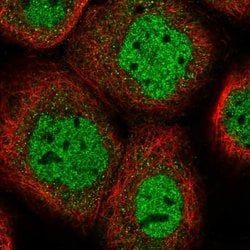
Description
- Immunogen sequence: MSSSPVKRQR MESALDQLKQ FTTVVADTGD FHAIDEYKPQ DATTNPSLIL AAAQMPAYQE LVEEAIAYGR KLGGS Transaldolase 1 is a key enzyme of the nonoxidative pentose phosphate pathway providing ribose-5-phosphate for nucleic acid synthesis and NADPH for lipid biosynthesis
- This pathway can also maintain glutathione at a reduced state and thus protect sulfhydryl groups and cellular integrity from oxygen radicals
- The functional gene of transaldolase 1 is located on chromosome 11 and a pseudogene is identified on chromosome 1 but there are conflicting map locations
- The second and third exon of this gene were developed by insertion of a retrotransposable element
- This gene is thought to be involved in multiple sclerosis.