LMTK2 Polyclonal Antibody, Invitrogen™
Manufacturer: Thermo Scientific
Select a Size
| Pack Size | SKU | Availability | Price |
|---|---|---|---|
| Each of 1 | PIPA5111142-Each-of-1 | In Stock | ₹ 48,905.50 |
PIPA5111142 - Each of 1
In Stock
Quantity
1
Base Price: ₹ 48,905.50
GST (18%): ₹ 8,802.99
Total Price: ₹ 57,708.49
Antigen
LMTK2
Classification
Polyclonal
Formulation
PBS with 40% glycerol and 0.02% sodium azide; pH 7.2
Gene Accession No.
Q8IWU2
Gene Symbols
LMTK2
Immunogen
Recombinant Protein corresonding to Human LMTK2
Quantity
100 μL
Primary or Secondary
Primary
Target Species
Human
Product Type
Antibody
Isotype
IgG
Applications
Immunocytochemistry
Conjugate
Unconjugated
Gene
LMTK2
Gene Alias
2900041G10Rik; A330101P12Rik; aatyk2; Apoptosis-associated tyrosine kinase 2; brain-enriched kinase; BREK; CDK5/p35-regulated kinase; cprk; cyclin-dependent kinase 5/p35-regulated kinase; FLJ46659; hBREK; Kiaa1079; kinase phosphatase inhibitor 2; kinase/phosphatase/inhibitor 2; KPI2; KPI-2; KPI-2 protein; Lemur tyrosine kinase 2; LMKT2; LMR2; Lmtk2; PPP1R100; protein phosphatase 1, regulatory subunit 100; serine/threonine-protein kinase KPI-2; Serine/threonine-protein kinase LMTK2
Host Species
Rabbit
Purification Method
Antigen affinity chromatography
Regulatory Status
RUO
Gene ID (Entrez)
22853
Content And Storage
Store at 4°C short term. For long term storage, store at -20°C, avoiding freeze/thaw cycles.
Form
Liquid
Related Products
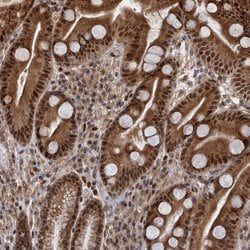

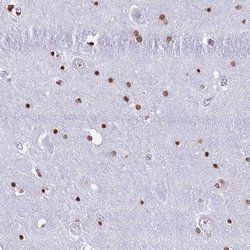
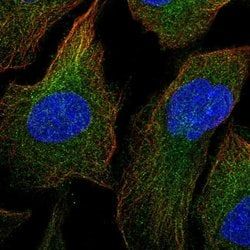
Description
- Immunogen sequence: MLTGDTLSTS LQSSPEVQVP PTSFETEETP RRVPPDSLPT QGETQPTCLD VIVPEDCLHQ DISPDAVTVP VEILSTDART HSLDNRSQDS PGESEETLRL TESDSVLADD ILASRVSVGS SLPELGQELH NKPFSEDHH Protein kinases are enzymes that transfer a phosphate group from a phosphate donor, generally the g phosphate of ATP, onto an acceptor amino acid in a substrate protein
- By this basic mechanism, protein kinases mediate most of the signal transduction in eukaryotic cells, regulating cellular metabolism, transcription, cell cycle progression, cytoskeletal rearrangement and cell movement, apoptosis, and differentiation
- With more than 500 gene products, the protein kinase family is one of the largest families of proteins in eukaryotes
- The family has been classified in 8 major groups based on sequence comparison of their tyrosine (PTK) or serine/threonine (STK) kinase catalytic domains
- The tyrosine kinase (TK) group is mainly involved in the regulation of cell-cell interactions such as differentiation, adhesion, motility and death
- There are currently about 90 TK genes sequenced, 58 are of receptor protein TK (e.g
- EGFR, EPH, FGFR, PDGFR, TRK, and VEGFR families), and 32 of cytosolic TK (e.g
- ABL, FAK, JAK, and SRC families).