SCARF1 Polyclonal Antibody, Invitrogen™
Manufacturer: Thermo Scientific
Select a Size
| Pack Size | SKU | Availability | Price |
|---|---|---|---|
| Each of 1 | PIPA5111705-Each-of-1 | In Stock | ₹ 48,905.50 |
PIPA5111705 - Each of 1
In Stock
Quantity
1
Base Price: ₹ 48,905.50
GST (18%): ₹ 8,802.99
Total Price: ₹ 57,708.49
Antigen
SCARF1
Classification
Polyclonal
Formulation
PBS with 40% glycerol and 0.02% sodium azide; pH 7.2
Gene Accession No.
Q14162
Gene Symbols
Scarf1
Immunogen
Recombinant Protein corresonding to Human SCARF1
Quantity
100 μL
Primary or Secondary
Primary
Target Species
Human
Product Type
Antibody
Isotype
IgG
Applications
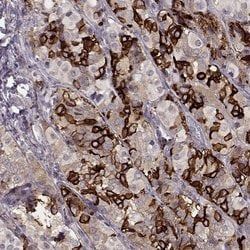
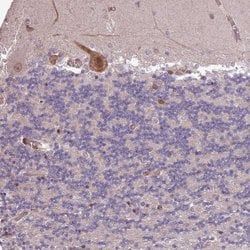
Immunohistochemistry
Conjugate
Unconjugated
Gene
Scarf1
Gene Alias
AA986099; acetyl LDL receptor; endothelial cells scavenger receptor; KIAA0149; MGC47738; mKIAA0149; SCARF1; Scavenger receptor class F member 1; scavenger receptor class F, member 1; scavenger receptor expressed by endothelial cells 1; Scavenger receptor expressed by endothelial cells 1 protein; SREC; SREC1; SREC-I
Host Species
Rabbit
Purification Method
Antigen affinity chromatography
Regulatory Status
RUO
Gene ID (Entrez)
8578
Content And Storage
Store at 4°C short term. For long term storage, store at -20°C, avoiding freeze/thaw cycles.
Form
Liquid
Related Products

Description
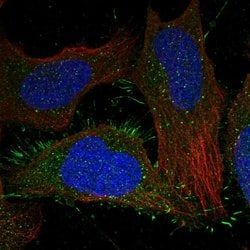
- Immunogen sequence: PNSAPKAGLP GATGPMAVRP EEAVRGLGAG TESSRRAQEP VSGCGSPEQD PQKQAEEERQ EEPEYENVVP I The protein encoded by this gene is a scavenger receptor that is expressed in endothelial cells and mediates the binding and degradation of acetylated low density lipoprotein (Ac-LDL)
- Transcription factors ZNF444/EZF-2 and SP1 are found to be responsible for the regulation of this gene
- Five alternatively spliced transcript variants encoding distinct isoforms have been described.