PIPA5113238
CHMP6 Polyclonal Antibody, Invitrogen™
Manufacturer: Thermo Scientific
Select a Size
| Pack Size | SKU | Availability | Price |
|---|---|---|---|
| Each of 1 | PIPA5113238-Each-of-1 | In Stock | ₹ 42,497.50 |
PIPA5113238 - Each of 1
In Stock
Quantity
1
Base Price: ₹ 42,497.50
GST (18%): ₹ 7,649.55
Total Price: ₹ 50,147.05
Antigen
CHMP6
Classification
Polyclonal
Conjugate
Unconjugated
Gene
CHMP6
Gene Alias
2400004G01Rik; Charged multivesicular body protein 6; Chmp6; chromatin modifying protein 6; chromatin-modifying protein 6; hVps20; novel SNF7 protein; RGD1565325; vacuolar protein sorting-associated protein 20; VPS20
Host Species
Rabbit
Purification Method
Protein G
Regulatory Status
RUO
Gene ID (Entrez)
287873, 79643
Content And Storage
-20°C or -80°C if preferred
Form
Liquid
Applications
ELISA, Immunohistochemistry (Paraffin), Western Blot
Concentration
4.87 mg/mL
Formulation
PBS with 50% glycerol and 0.03% ProClin 300; pH 7.4
Gene Accession No.
Q96FZ7
Gene Symbols
CHMP6
Immunogen
Recombinant Human Charged multivesicular body protein 6 protein (2-201AA)
Quantity
100 μg
Primary or Secondary
Primary
Target Species
Human, Rat
Product Type
Antibody
Isotype
IgG
Related Products



Description
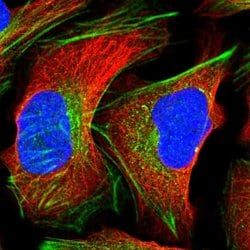
- CHMP6 belongs to the chromatin-modifying protein/charged multivesicular body protein (CHMP) family
- These proteins are components of ESCRT-III (endosomal sorting complex required for transport III), a complex involved in degradation of surface receptor proteins and formation of endocytic multivesicular bodies (MVBs)
- Some CHMPs have both nuclear and cytoplasmic/vesicular distributions, and one such CHMP, CHMP1A, is required for both MVB formation and regulation of cell cycle progression (Tsang et al., 2006 ).