ADARB1 Polyclonal Antibody, Invitrogen™
Manufacturer: Thermo Scientific
Select a Size
| Pack Size | SKU | Availability | Price |
|---|---|---|---|
| Each of 1 | PIPA5113687-Each-of-1 | In Stock | ₹ 46,502.50 |
PIPA5113687 - Each of 1
In Stock
Quantity
1
Base Price: ₹ 46,502.50
GST (18%): ₹ 8,370.45
Total Price: ₹ 54,872.95
Antigen
ADARB1
Classification
Polyclonal
Conjugate
Unconjugated
Gene
ADARB1
Gene Alias
1700057H01Rik; Adar2; Adarb1; adenosine deaminase, RNA specific B1; adenosine deaminase, RNA-specific, B1; adenosine deaminase, RNA-specific, B1 (homolog of rat RED1); adenosine deaminase, RNA-specific, B1 (RED1 homolog rat); AW124433; AW558573; BB220382; D10Bwg0447e; Double-stranded RNA-specific editase 1; DRABA2; DRADA2; dsRNA adenosine deaminase; dsRNA adenosine deaminase DRADA2; Red1; RED1 homolog; RNA editase; RNA editing deaminase 1; RNA editing deaminase of glutamate receptors; RNA-editing deaminase 1; RNA-editing enzyme 1
Host Species
Rabbit
Purification Method
Affinity chromatography
Regulatory Status
RUO
Gene ID (Entrez)
104
Content And Storage
-20° C, Avoid Freeze/Thaw Cycles
Form
Liquid
Applications
Western Blot
Concentration
0.5 mg/mL
Formulation
PBS with 2% sucrose and 0.09% sodium azide
Gene Accession No.
P78563
Gene Symbols
ADARB1
Immunogen
Synthetic peptide directed towards the N terminal region of human ADARB1
Quantity
100 μL
Primary or Secondary
Primary
Target Species
Human
Product Type
Antibody
Isotype
IgG
Related Products
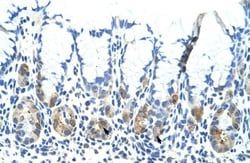
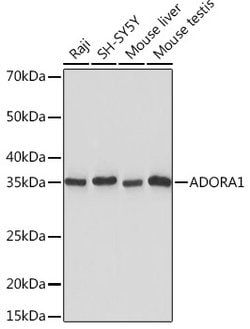
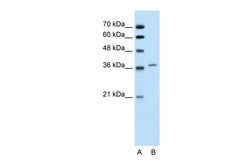
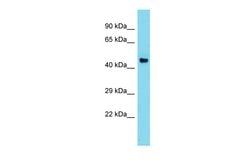

Description
- Immunogen sequence: NMSSSSTDVK ENRNLDNVSP KDGSTPGPGE GSQLSNGGGG GPGRKRPLEE For short term use, store at 2-8°C up to 1 week
- For long term storage, store at -20°C in small aliquots to prevent freeze-thaw cycles
- Predicted homology: Cow: 83%; Dog: 92%; Horse: 92%; Human: 100%; Mouse: 92%; Rat: 92% Catalyzes the hydrolytic deamination of adenosine to inosine in double-stranded RNA (dsRNA) referred to as A-to-I RNA editing
- This may affect gene expression and function in a number of ways that include mRNA translation by changing codons and hence the amino acid sequence of proteins; pre-mRNA splicing by altering splice site recognition sequences; RNA stability by changing sequences involved in nuclease recognition; genetic stability in the case of RNA virus genomes by changing sequences during viral RNA replication; and RNA structure-dependent activities such as microRNA production or targeting or protein-RNA interactions
- Can edit both viral and cellular RNAs and can edit RNAs at multiple sites (hyper-editing) or at specific sites (site-specific editing)
- Its cellular RNA substrates include: bladder cancer-associated protein (BLCAP), neurotransmitter receptors for glutamate (GRIA2 and GRIK2) and serotonin (HTR2C), GABA receptor (GABRA3) and potassium voltage-gated channel (KCNA1)
- Site-specific RNA editing of transcripts encoding these proteins results in amino acid substitutions which consequently alter their functional activities
- Edits GRIA2 at both the Q/R and R/G sites efficiently but converts the adenosine in hotspot1 much less efficiently
- Can exert a proviral effect towards human immunodeficiency virus type 1 (HIV-1) and enhances its replication via both an editing-dependent and editing-independent mechanism
- The former involves editing of adenosines in the 5'UTR while the latter occurs via suppression of EIF2AK2/PKR activation and function
- Can inhibit cell proliferation and migration and can stimulate exocytosis.