BAK Polyclonal Antibody, Invitrogen™
Manufacturer: Thermo Scientific
Select a Size
| Pack Size | SKU | Availability | Price |
|---|---|---|---|
| Each of 1 | PIPA511377-Each-of-1 | In Stock | ₹ 48,905.50 |
PIPA511377 - Each of 1
In Stock
Quantity
1
Base Price: ₹ 48,905.50
GST (18%): ₹ 8,802.99
Total Price: ₹ 57,708.49
Antigen
BAK
Classification
Polyclonal
Formulation
PBS with 0.09% sodium azide
Gene Accession No.
Q16611
Gene Symbols
BAK1
Immunogen
KLH conjugated synthetic peptide between 56-91 amino acids from human Bak
Quantity
400 μL
Primary or Secondary
Primary
Target Species
Human
Product Type
Antibody
Isotype
IgG
Applications
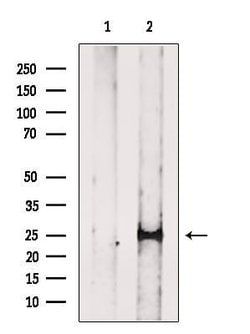
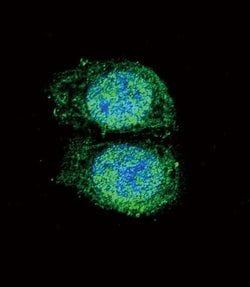
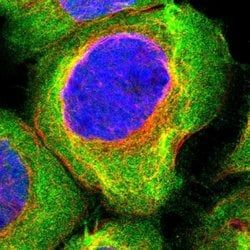
Immunohistochemistry (Paraffin), Western Blot
Conjugate
Unconjugated
Gene
BAK1
Gene Alias
Apoptosis regulator BAK; BAK; Bak1; BAK-LIKE; BCL2 antagonist/killer 1; Bcl2 homologous antagonist/killer; Bcl-2 homologous antagonist/killer; BCL2-antagonist/killer 1; BCL2L7; bcl2-L-7; BCL2-like 7 protein; BCL2-like 7protein; bcl-2-like protein 7; Bcl-2-likeous antagonist/killer; CDN1; MGC117255; MGC3887; N-Bak; N-BAK1; pro-apoptotic protein BAK
Host Species
Rabbit
Purification Method
Antigen affinity chromatography, Protein A
Regulatory Status
RUO
Gene ID (Entrez)
578
Content And Storage
-20° C, Avoid Freeze/Thaw Cycles
Form
Liquid
Related Products

Description
- The protein encoded by this gene belongs to the BCL2 protein family
- BCL2 family members form oligomers or heterodimers and act as anti- or pro-apoptotic regulators that are involved in a wide variety of cellular activities
- This protein localizes to mitochondria, and functions to induce apoptosis
- It interacts with and accelerates the opening of the mitochondrial voltage-dependent anion channel, which leads to a loss in membrane potential and the release of cytochrome c
- This protein also interacts with the tumor suppressor P53 after exposure to cell stress.