Phospho-PKC mu (Ser910) Polyclonal Antibody, Invitrogen™
Manufacturer: Thermo Scientific
Select a Size
| Pack Size | SKU | Availability | Price |
|---|---|---|---|
| Each of 1 | PIPA5114624-Each-of-1 | In Stock | ₹ 46,502.50 |
PIPA5114624 - Each of 1
In Stock
Quantity
1
Base Price: ₹ 46,502.50
GST (18%): ₹ 8,370.45
Total Price: ₹ 54,872.95
Antigen
Phospho-PKC mu (Ser910)
Classification
Polyclonal
Conjugate
Unconjugated
Gene
PRKD1
Gene Alias
4930557O20Rik; 5730497N19Rik; AI325941; DKFZP586E0820; EPK2; HSPC187; nPKC-D1; nPKC-D2; nPKC-mu; nPKC-nu; PKC mu; PKC nu; PKC u; PKC v; Pkcm; PKCmu; PKC-MU; Pkcnu; PKC-NU; PKCu; PKC-u; PKCv; PKC-v; Pkd; PKD1; PKD2; PKD3; Prkcm; PRKCN; Prkd1; PRKD2; PRKD3; Protein kinase C mu type; protein kinase C nu type; protein kinase C, mu; protein kinase C, nu; protein kinase D; protein kinase D1; protein kinase D2; protein kinase D3; protein kinase EPK2; RGD1308054; Serine/threonine-protein kinase D1; serine/threonine-protein kinase D2; Serine/threonine-protein kinase D3
Host Species
Rabbit
Purification Method
sequential chromatography
Regulatory Status
RUO
Gene ID (Entrez)
101540, 18760, 23683, 25865, 5587, 75292
Content And Storage
-20°C
Form
Liquid
Applications
Western Blot
Concentration
1 mg/mL
Formulation
PBS with 50% glycerol and 0.02% sodium azide
Gene Accession No.
O94806, Q15139, Q62101, Q8BZ03, Q8K1Y2, Q9BZL6
Gene Symbols
PRKD1, Prkd2, Prkd3
Immunogen
A synthesized peptide derived from human PKD1/PKC mu around the phosphorylation site of Ser910.
Quantity
100 μL
Primary or Secondary
Primary
Target Species
Human, Mouse
Product Type
Antibody
Isotype
IgG
Related Products
Description
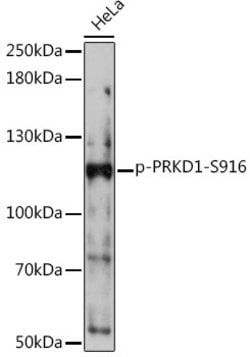
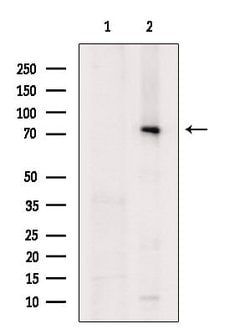
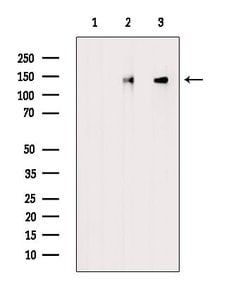
- Antibody detects endogenous levels of PKD1/PKC mu only when phosphorylated at Ser910
- The PKC family of serine/threonine kinases, including PRKCN (PKD3), is activated intracellularly by signal transduction pathways
- In humans, at least 12 different PKC polypeptides have been identified
- These isoforms differ in primary structure, tissue distribution, subcellular localization, mode of action in vitro, response to extracellular signals, and substrate specificity
- PKC alpha, beta I, beta II and gamma form the conventional family; their activities are Ca2+- and phospholipid-dependent
- PKC mu activation is dependent on the phosphorylation of two activation loop sites, Ser744 and Ser748, via a PKC-dependent signaling pathway.