ACAP2 Polyclonal Antibody, Invitrogen™
Manufacturer: Thermo Scientific
Select a Size
| Pack Size | SKU | Availability | Price |
|---|---|---|---|
| Each of 1 | PIPA5114808-Each-of-1 | In Stock | ₹ 46,502.50 |
PIPA5114808 - Each of 1
In Stock
Quantity
1
Base Price: ₹ 46,502.50
GST (18%): ₹ 8,370.45
Total Price: ₹ 54,872.95
Antigen
ACAP2
Classification
Polyclonal
Conjugate
Unconjugated
Gene
ACAP2
Gene Alias
4832442G16; 9530039J15Rik; ACAP2; Arf GAP with coiled coil, ANK repeat and PH domains 2; arf-GAP with coiled-coil, ANK repeat and PH domain-containing protein 2; ArfGAP with coiled-coil, ankyrin repeat and PH domains 2; centaurin beta2; centaurin, beta 2; centaurin-beta-2; Centb2; CNT-B2; KIAA0041; mKIAA0041
Host Species
Rabbit
Purification Method
Affinity chromatography
Regulatory Status
RUO
Gene ID (Entrez)
23527, 619382, 78618
Content And Storage
-20°C
Form
Liquid
Applications
Immunocytochemistry, Western Blot
Concentration
1 mg/mL
Formulation
PBS with 50% glycerol and 0.02% sodium azide
Gene Accession No.
Q15057, Q5FVC7, Q6ZQK5
Gene Symbols
ACAP2
Immunogen
A synthesized peptide derived from human ACAP2(Accession Q15057), corresponding to amino acid residues G746-F778.
Quantity
100 μL
Primary or Secondary
Primary
Target Species
Human, Mouse, Non-human Primate, Rat
Product Type
Antibody
Isotype
IgG
Related Products
Description
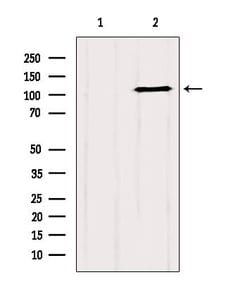
- Antibody detects endogenous levels of total ACAP2
- ACAP2 is a transport carrier belonging to the Centaurin family with three ANK repeats, an Arf-GAP domain, a BAR domain, and a PH domain
- ACAP2, a GTPase-activating protein (GAP) for ADP ribosylation factor 6 (ARF6) has robust constitutive ARF6 GAP activity, where the GAP activity is stimulated by phosphatidylinositol 4,5-bisphosphate (PIP2) and phosphatidic acid but has little activity toward ARF1 and is known to control the return of ARF to the inactive GDB-bound shots
- ACAP2, along with ACAP1, is targeted by phosphatidyl inositol (3, 4, 3) triphosphate inhibiting the formation of PDGF-induced dorsal membrane ruffles in NIH3T3 fibroblasts when overexpressed
- ACAP2 is phosphorylated upon DNA damage, probably by ATM or ATR
- Expression is wide-spread with the highest level in lung.