PIPA5142103
SUFU Polyclonal Antibody, Invitrogen™
Manufacturer: Thermo Scientific
Select a Size
| Pack Size | SKU | Availability | Price |
|---|---|---|---|
| Each of 1 | PIPA5142103-Each-of-1 | In Stock | ₹ 40,317.00 |
PIPA5142103 - Each of 1
In Stock
Quantity
1
Base Price: ₹ 40,317.00
GST (18%): ₹ 7,257.06
Total Price: ₹ 47,574.06
Antigen
SUFU
Classification
Polyclonal
Conjugate
Unconjugated
Gene
SUFU
Gene Alias
OTTHUMP00000020377; OTTHUMP00000020378; OTTHUMP00000020379; PRO1280; RP11-47A8.1; Su(fu); Sufu; SUFU negative regulator of hedgehog signaling; SUFUH; SUFUXL; suppressor of fused homolog; suppressor of fused homolog (Drosophila); UNQ650/PRO1280
Host Species
Goat
Purification Method
Ammonium sulfate precipitation
Regulatory Status
RUO
Gene ID (Entrez)
51684
Content And Storage
-20° C, Avoid Freeze/Thaw Cycles
Isotype
IgG
Applications
Immunohistochemistry (Paraffin)
Concentration
0.5 mg/mL
Formulation
TBS with 0.5% BSA and 0.02% sodium azide; pH 7.3
Gene Accession No.
Q9UMX1
Gene Symbols
SUFU
Immunogen
Peptide with sequence AELRPSGAPGPT-C.
Quantity
100 μg
Primary or Secondary
Primary
Target Species
Human
Form
Liquid
Related Products

Description
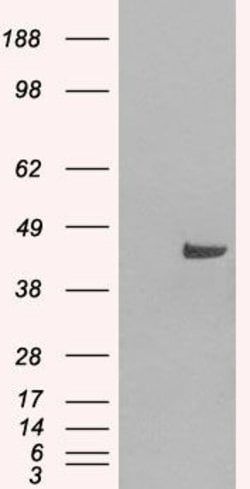
- Additional Information: This antibody is expected to recognize both reported isoforms (NP_057253.2; NP_001171604.1)
- This antibody is tested in Peptide ELISA: antibody detection limit dilution 1:32,000
- The Hedgehog signaling pathway plays an important role in early human development
- The pathway is a signaling cascade that plays a role in pattern formation and cellular proliferation during development
- This gene encodes a negative regulator of the hedgehog signaling pathway
- Defects in this gene are a cause of medulloblastoma
- Alternative splicing results in multiple transcript variants.