PIPA5143220
VASP Polyclonal Antibody, Invitrogen™
Manufacturer: Thermo Scientific
Select a Size
| Pack Size | SKU | Availability | Price |
|---|---|---|---|
| Each of 1 | PIPA5143220-Each-of-1 | In Stock | ₹ 40,317.00 |
PIPA5143220 - Each of 1
In Stock
Quantity
1
Base Price: ₹ 40,317.00
GST (18%): ₹ 7,257.06
Total Price: ₹ 47,574.06
Antigen
VASP
Classification
Polyclonal
Conjugate
Unconjugated
Gene
VASP
Gene Alias
Enah/Vasp-like; I79_012660; Unknown (protein for MGC:127789); vasodilator stimulated phosphoprotein; vasodilator-stimulated phosphoprotein; vasodilator-stimulated phosphoprotein (VASP); VASP
Host Species
Goat
Purification Method
Ammonium sulfate precipitation
Regulatory Status
RUO
Gene ID (Entrez)
22323, 7408
Content And Storage
-20° C, Avoid Freeze/Thaw Cycles
Isotype
IgG
Applications
Western Blot
Concentration
0.5 mg/mL
Formulation
TBS with 0.5% BSA and 0.02% sodium azide; pH 7.3
Gene Accession No.
P50552, P70460
Gene Symbols
VASP
Immunogen
Peptide with sequence C-RKVSKQEEASGGPT.
Quantity
100 μg
Primary or Secondary
Primary
Target Species
Human, Mouse
Form
Liquid
Related Products

Description
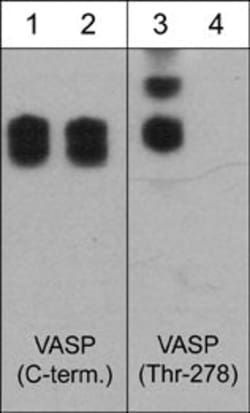
- This antibody is tested in Peptide ELISA: antibody detection limit dilution 1:128,000
- Vasodilator-stimulated phosphoprotein (VASP) is a member of the Ena-VASP protein family
- Ena-VASP family members contain an EHV1 N-terminal domain that binds proteins containing E/DFPPPPXD/E motifs and targets Ena-VASP proteins to focal adhesions
- In the mid-region of the protein, family members have a proline-rich domain that binds SH3 and WW domain-containing proteins
- Their C-terminal EVH2 domain mediates tetramerization and binds both G and F actin
- VASP is associated with filamentous actin formation and likely plays a widespread role in cell adhesion and motility
- VASP may also be involved in the intracellular signaling pathways that regulate integrin-extracellular matrix interactions
- VASP is regulated by the cyclic nucleotide-dependent kinases PKA and PKG.