PIPA517146
STIM2 Polyclonal Antibody, Invitrogen™
Manufacturer: Thermo Scientific
Select a Size
| Pack Size | SKU | Availability | Price |
|---|---|---|---|
| Each of 1 | PIPA517146-Each-of-1 | In Stock | ₹ 40,406.00 |
PIPA517146 - Each of 1
In Stock
Quantity
1
Base Price: ₹ 40,406.00
GST (18%): ₹ 7,273.08
Total Price: ₹ 47,679.08
Antigen
STIM2
Classification
Polyclonal
Formulation
0.01M HEPES with 0.15M NaCl, 100μg/mL BSA, 50% glycerol and no preservative; pH 7.5
Gene Accession No.
P83093, Q9P246
Gene Symbols
STIM2
Immunogen
Synthetic peptide corresponding to the sequence of human STIM2
Quantity
100 μL
Primary or Secondary
Primary
Target Species
Human, Mouse, Non-human Primate, Rat
Product Type
Antibody
Isotype
IgG
Applications
Immunocytochemistry, Western Blot
Conjugate
Unconjugated
Gene
STIM2
Gene Alias
Kiaa1482; OTTHUMP00000123457; OTTHUMP00000123458; OTTHUMP00000216198; Stim2; Stromal interaction molecule 2
Host Species
Rabbit
Purification Method
Antigen affinity chromatography
Regulatory Status
RUO
Gene ID (Entrez)
116873, 117087, 57620
Content And Storage
-20°C
Form
Liquid
Related Products



Description
- It is not recommended to aliquot this antibody
- In T lymphocytes, the sole pathway for Ca++ entry following antigen-receptor binding is through store-operated Ca++-release-activated Ca++ (CRAC) channels
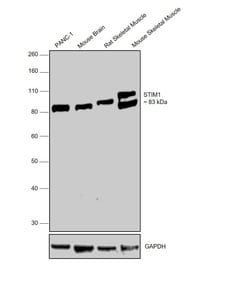
- These channels are made up of the pore-forming subunit ORAI1 and the stromal interaction molecule 1 (STIM1), a protein that functions as a Ca++ sensor and activates the CRAC channels, migrating to the plasma membrane from endoplasmic reticulum (ER)-like sites which act as the Ca++ store
- A related molecule, STIM2, acts to inhibit the STIM1-mediated store-operated Ca++ entry, and can form complexes with STIM1, suggesting they may play a coordinated role in controlling Ca++ entry
- At least three isoforms of STIM2 are known to exist.