UCHL3 Polyclonal Antibody, Invitrogen™
Manufacturer: Thermo Scientific
Select a Size
| Pack Size | SKU | Availability | Price |
|---|---|---|---|
| Each of 1 | PIPA517206-Each-of-1 | In Stock | ₹ 40,406.00 |
PIPA517206 - Each of 1
In Stock
Quantity
1
Base Price: ₹ 40,406.00
GST (18%): ₹ 7,273.08
Total Price: ₹ 47,679.08
Antigen
UCHL3
Classification
Polyclonal
Formulation
0.01M HEPES with 0.15M NaCl, 100μg/mL BSA, 50% glycerol and no preservative; pH 7.5
Gene Accession No.
P15374, Q91Y78, Q9JKB1
Gene Symbols
UCHL3
Immunogen
Synthetic peptide corresponding to residues surrounding Leu220 of human UCHL3 protein
Quantity
100 μL
Primary or Secondary
Primary
Target Species
Human, Mouse, Non-human Primate, Rat
Product Type
Antibody
Isotype
IgG
Applications
Western Blot
Conjugate
Unconjugated
Gene
UCHL3
Gene Alias
RGD1561196; testicular tissue protein Li 221; ubiquitin carboxyl-terminal esterase L3 (ubiquitin thiolesterase); ubiquitin carboxyl-terminal hydrolase isozyme L3; ubiquitin C-terminal hydrolase L3; Ubiquitin thioesterase L3; ubiquitin thiolesterase; UCHL3; UCH-L3
Host Species
Rabbit
Purification Method
Antigen affinity chromatography
Regulatory Status
RUO
Gene ID (Entrez)
498560, 50933, 7347
Content And Storage
-20°C
Form
Liquid
Related Products


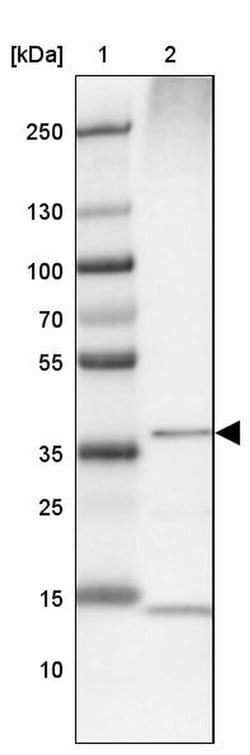
Description
- It is not recommended to aliquot this antibody
- Regulatory associated protein of mTOR (RAPTOR) is a binding partner of target of rapamycin (TOR)
- It binds to 4EBP1 and p70alpha
- The binding of raptor to mTOR is essential for the mTOR-catalyzed phosphorylation of 4EBP1 in vitro
- It enhances the mTOR kinase activity toward p70alpha
- It is also an essential scaffold for the mTOR-catalyzed phosphorylation of 4EBP1 and mediates TOR action in vivo.