PIPA520985
TCTN3 Polyclonal Antibody, Invitrogen™
Manufacturer: Thermo Scientific
Select a Size
| Pack Size | SKU | Availability | Price |
|---|---|---|---|
| Each of 1 | PIPA520985-Each-of-1 | In Stock | ₹ 46,502.50 |
PIPA520985 - Each of 1
In Stock
Quantity
1
Base Price: ₹ 46,502.50
GST (18%): ₹ 8,370.45
Total Price: ₹ 54,872.95
Antigen
TCTN3
Classification
Polyclonal
Conjugate
Unconjugated
Gene
TCTN3
Gene Alias
4930521E07Rik; AI197391; C10orf61; JBTS18; OFD4; PSEC0041; RGD1305166; RP11-7D5.3; TCTN3; Tect3; tectonic 3; tectonic family member 3; tectonic-3; UNQ1881/PRO4324
Host Species
Rabbit
Purification Method
Antigen affinity chromatography
Regulatory Status
RUO
Gene ID (Entrez)
26123, 309486, 67590
Content And Storage
Maintain refrigerated at 2-8°C for up to 3 months. For long term storage store at -20°C
Form
Liquid
Applications
Immunohistochemistry, Western Blot
Concentration
1 mg/mL
Formulation
PBS with 0.02% sodium azide
Gene Accession No.
Q6NUS6, Q8R2Q6
Gene Symbols
TCTN3
Immunogen
A 17 amino acid peptide near the carboxy terminus of human TCTN3.
Quantity
100 μg
Primary or Secondary
Primary
Target Species
Human, Mouse, Rat
Product Type
Antibody
Isotype
IgG
Related Products
Description
- A suggested positive control is SK-N-SH cell lysate
- PA5-20985 can be used with blocking peptide PEP-1099
- TCTN3 is a member of the Tectonic protein family, a group of evolutionarily conserved secreted and transmembrane proteins that regulate the Hedgehog (Hh)-mediated patterning of the neural tube
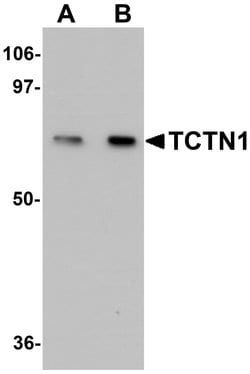
- While the expression pattern and function of TCTN3 is not known, it is 58% similar to TCTN1
- TCTN1 is expressed during embryonic development in regions that participate in Hh signaling, beginning in the gastrulation stages in the ventral node
- Mice expressing mutant TCTN1 die between E13.5 and E16.5 and display holoprosencephaly, a defect associated with reduced Hh signaling, indicating the role of TCTN1 as an Hh activator
- At later stages in development, TCTN1 is thought to also act as a repressor on the Hh pathway in the anterior and posterior neural tube.