ATP2C2 Polyclonal Antibody, Invitrogen™
Manufacturer: Thermo Scientific
Select a Size
| Pack Size | SKU | Availability | Price |
|---|---|---|---|
| Each of 1 | PIPA521127-Each-of-1 | In Stock | ₹ 46,057.50 |
PIPA521127 - Each of 1
In Stock
Quantity
1
Base Price: ₹ 46,057.50
GST (18%): ₹ 8,290.35
Total Price: ₹ 54,347.85
Antigen
ATP2C2
Classification
Polyclonal
Conjugate
Unconjugated
Gene
ATP2C2
Gene Alias
1810010G06Rik; Atp2c2; ATPase 2C2; ATPase secretory pathway Ca2+ transporting 2; ATPase, Ca++ transporting, type 2C, member 2; calcium-transporting ATPase type 2C member 2; Kiaa0703; mKIAA0703; Secretory pathway Ca(2+)-ATPase 2; secretory pathway Ca2+-ATPase; secretory pathway calcium ATPase 2; Spca2
Host Species
Rabbit
Purification Method
Antigen affinity chromatography
Regulatory Status
RUO
Gene ID (Entrez)
69047, 9914
Content And Storage
Maintain refrigerated at 2-8°C for up to 3 months. For long term storage store at -20°C
Form
Liquid
Applications
Western Blot
Concentration
1 mg/mL
Formulation
PBS with 0.02% sodium azide
Gene Accession No.
A7L9Z8, O75185
Gene Symbols
ATP2C2
Immunogen
A 19 amino acid peptide near the amino terminus of human ATP2C2.
Quantity
100 μg
Primary or Secondary
Primary
Target Species
Human, Mouse
Product Type
Antibody
Isotype
IgG
Related Products
Description
- A suggested positive control is NIH-3T3 cell lysate
- PA5-21127 can be used with blocking peptide PEP-1241
- ATP2C2, also known as secretory pathway Ca2+/Mn2+-ATPase (SPCA) 2, belongs to the family of P-type cation transport ATPases
- This magnesium-dependent enzyme catalyzes the hydrolysis of ATP coupled with the transport of the calcium from the cytosol to the Golgi lumen
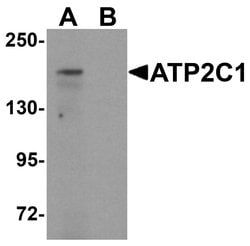
- Defects in the related gene ATP2C1 cause Hailey-Hailey disease, for which ATP2C2 does not compensate, suggesting that ATP2C2 plays other physiological roles
- Unlike ATP2C1, ATP2C2 has a much more restricted expression pattern and displays a higher maximal turnover rate for overall Ca2+-ATPase reaction and a lower apparent affinity for cytosolic Ca2+ activation of phosphorylation
- Overexpression of ATP2C2 in mammary tumors result a Ca2+ influx via the store-operated Ca2+ channel ORAI1 and independent of the STIM1 and STIM2 sensors.