GSTO2 Polyclonal Antibody, Invitrogen™
Manufacturer: Thermo Scientific
Select a Size
| Pack Size | SKU | Availability | Price |
|---|---|---|---|
| Each of 1 | PIPA525736-Each-of-1 | In Stock | ₹ 48,905.50 |
PIPA525736 - Each of 1
In Stock
Quantity
1
Base Price: ₹ 48,905.50
GST (18%): ₹ 8,802.99
Total Price: ₹ 57,708.49
Antigen
GSTO2
Classification
Polyclonal
Conjugate
Unconjugated
Gene
Gsto2
Gene Alias
1700020F09Rik; 4930425C18Rik; bA127L20.1; bA127L20.1 (novel glutathione-S-transferase); glutathione S-transferase omega 2; glutathione S-transferase omega 2-2; Glutathione S-transferase omega-2; glutathione-dependent dehydroascorbate reductase; glutathione-S-transferase-like protein; GSTO 2-2; Gsto2; GSTO-2; LOC100720364; MMA(V) reductase; monomethylarsonic acid reductase
Host Species
Rabbit
Purification Method
Antigen affinity chromatography, Protein A
Regulatory Status
RUO
Gene ID (Entrez)
119391, 68214
Content And Storage
-20° C, Avoid Freeze/Thaw Cycles
Form
Liquid
Applications
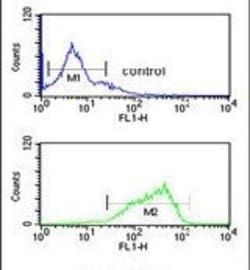
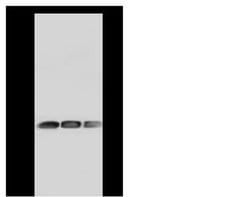
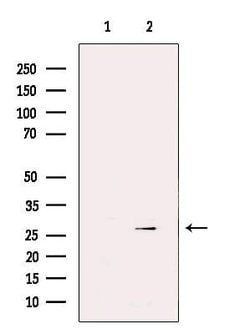
Flow Cytometry, Immunocytochemistry, Western Blot
Concentration
0.5 mg/mL
Formulation
PBS with 0.09% sodium azide
Gene Accession No.
Q8K2Q2, Q9H4Y5
Gene Symbols
Gsto2
Immunogen
KLH conjugated synthetic peptide between 82-110 amino acids from the central region of human GSTO2
Quantity
400 μL
Primary or Secondary
Primary
Target Species
Human, Mouse
Product Type
Antibody
Isotype
IgG
Related Products

Description
- The omega class glutathione transferases (GST; EC 2.5.1.18) have poor activity with common GST substrates, but exhibit novel glutathione-dependent thioltransferase, dehydroascorbate reductase, and monomethylarsonate reductase activities, and they modulate Ca(2+) release by ryanodine receptors (e.g., RYR1).