C/EBP alpha Polyclonal Antibody, Invitrogen™
Manufacturer: Thermo Scientific
Select a Size
| Pack Size | SKU | Availability | Price |
|---|---|---|---|
| Each of 1 | PIPA526487-Each-of-1 | In Stock | ₹ 48,905.50 |
PIPA526487 - Each of 1
In Stock
Quantity
1
Base Price: ₹ 48,905.50
GST (18%): ₹ 8,802.99
Total Price: ₹ 57,708.49
Antigen
C/EBP alpha
Classification
Polyclonal
Conjugate
Unconjugated
Gene
CEBPA
Gene Alias
C EBP; C/EBP; c/EBP alpha; C/EBPa; C/ebpalpha; C/EBP-alpha; CAAT/enhancer-binding protein DNA-binding protein; CAAT/enhancer-binding protein, DNA-binding protein; CBF-A; CCAAT enhancer binding protein alpha; CCAAT/enhancer binding protein (C/EBP), alpha; CCAAT/enhancer binding protein alpha; CCAAT/enhancer binding protein, alpha; CCAAT/enhancer-binding protein alpha; Cebp; Cebpa; DBPCEP; OTTHUMP00000220269
Host Species
Rabbit
Purification Method
Antigen affinity chromatography, Protein A
Regulatory Status
RUO
Gene ID (Entrez)
1050, 12606
Content And Storage
-20° C, Avoid Freeze/Thaw Cycles
Form
Liquid
Applications
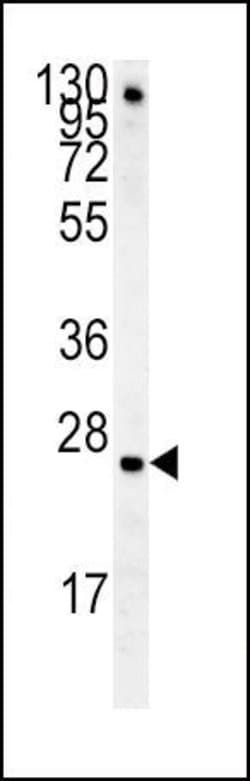
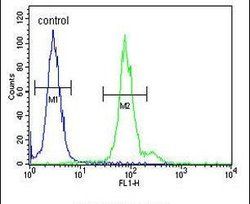
Flow Cytometry, Western Blot
Concentration
0.36 mg/mL
Formulation
PBS with 0.09% sodium azide
Gene Accession No.
P49715, P53566
Gene Symbols
CEBPA
Immunogen
KLH conjugated synthetic peptide between 304-330 amino acids from the C-terminal region of human CEBPA
Quantity
400 μL
Primary or Secondary
Primary
Target Species
Human, Mouse
Product Type
Antibody
Isotype
Ig
Related Products

Description
- This antibody is predicted to react with bovine and rat based on sequence homology
- The C/EBP (CCAAT/enhancer binding protein) family of transcription factors--alpha, beta, delta, and epsilon)--are widely expressed proteins found in a variety of tissues
- These domains contain an evolutionarily conserved five-amino acid motif (the regulatory domain motif RDM) that conforms to the consensus sequence (I/V/L) KXEP
- One of the major roles of these transcription factors is that of metabolic regulation in liver and fat cells
- Studies suggest that these transcription factors act in a cascade aiding in the development of the adipose cell
- Three C/EBP beta isoforms (LAP*, LAP, and LIP) arise from different translation initiation and display different function in gene regulation
- From a neurological standpoint, C/EBPs have been implicated in the mediation of nerve growth factor, altering synaptic plasticity, and mediation of inflammatory response in AD patients.