EEF2 Polyclonal Antibody, Invitrogen™
Manufacturer: Thermo Scientific
Select a Size
| Pack Size | SKU | Availability | Price |
|---|---|---|---|
| Each of 1 | PIPA527662-Each-of-1 | In Stock | ₹ 49,439.50 |
PIPA527662 - Each of 1
In Stock
Quantity
1
Base Price: ₹ 49,439.50
GST (18%): ₹ 8,899.11
Total Price: ₹ 58,338.61
Antigen
EEF2
Classification
Polyclonal
Conjugate
Unconjugated
Gene
EEF2
Gene Alias
EEF2; EEF-2; Ef2; EF-2; Elongation factor 2; elongation factor-2; eukaryotic translation elongation factor 2; I79_013848; polypeptidyl-tRNA translocase; SCA26; zef2
Host Species
Rabbit
Purification Method
Antigen affinity chromatography
Regulatory Status
RUO
Gene ID (Entrez)
13629, 1938, 29565
Content And Storage
Store at 4°C short term. For long term storage, store at -20°C, avoiding freeze/thaw cycles.
Form
Liquid
Applications
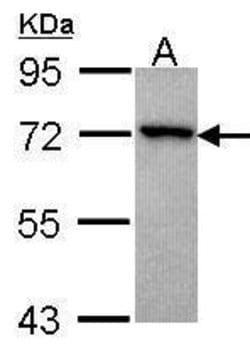
Immunohistochemistry (Paraffin), Western Blot
Concentration
0.86 mg/mL
Formulation
0.1M tris glycine with 10% glycerol and 0.01% thimerosal; pH 7
Gene Accession No.
P05197, P13639, P58252
Gene Symbols
EEF2
Immunogen
Recombinant fragment corresponding to a region within amino acids 220 and 500 of Human EEF2
Quantity
100 μL
Primary or Secondary
Primary
Target Species
Human, Mouse, Rat
Product Type
Antibody
Isotype
IgG
Related Products






Description
- Recommended positive controls: 293T, A431, Neuro2A, NIH-3T3, Neuro 2A, Raw264.7, PC-12
- Predicted reactivity: Mouse (98%), Rat (98%), Chicken (95%), Rhesus Monkey (99%), Bovine (98%)
- Store product as a concentrated solution
- Centrifuge briefly prior to opening the vial
- Catalyzes the GTP-dependent ribosomal translocation step during translation elongation
- During this step, the ribosome changes from the pre-translocational (PRE) to the post-translocational (POST) state as the newly formed A-site-bound peptidyl-tRNA and P-site-bound deacylated tRNA move to the P and E sites, respectively
- Catalyzes the coordinated movement of the two tRNA molecules, the mRNA and conformational changes in the ribosome.