beta-1 Adrenergic Receptor Polyclonal Antibody, Invitrogen™
Manufacturer: Thermo Scientific
Select a Size
| Pack Size | SKU | Availability | Price |
|---|---|---|---|
| Each of 1 | PIPA528808-Each-of-1 | In Stock | ₹ 49,083.50 |
PIPA528808 - Each of 1
In Stock
Quantity
1
Base Price: ₹ 49,083.50
GST (18%): ₹ 8,835.03
Total Price: ₹ 57,918.53
Antigen
beta-1 Adrenergic Receptor
Classification
Polyclonal
Conjugate
Unconjugated
Gene
ADRB1
Gene Alias
Adrb1; Adrb-1; ADRB1R; adrenergic receptor, beta 1; adrenergic, beta-1-, receptor; adrenoceptor beta 1; B1AR; beta 1-adrenergic receptor beta 1-AR; beta 1-AR; beta-1 adrenergic receptor; Beta-1 adrenoceptor; beta-1 adrenoreceptor; BETA1AR; beta-AR; cardiac beta adrenergic receptor; RATB1AR; RHR
Host Species
Rabbit
Purification Method
Antigen affinity chromatography
Regulatory Status
RUO
Gene ID (Entrez)
153
Content And Storage
Store at 4°C short term. For long term storage, store at -20°C, avoiding freeze/thaw cycles.
Form
Liquid
Applications
Immunocytochemistry, Immunohistochemistry (Paraffin), Western Blot
Concentration
1 mg/mL
Formulation
0.1M tris glycine with 10% glycerol and 0.01% thimerosal; pH 7
Gene Accession No.
P08588
Gene Symbols
ADRB1
Immunogen
Synthetic peptide corresponding to a region within amino acids 414 and 477 of Human beta 1 Adrenergic Receptor
Quantity
100 μL
Primary or Secondary
Primary
Target Species
Human
Product Type
Antibody
Isotype
IgG
Related Products


Description
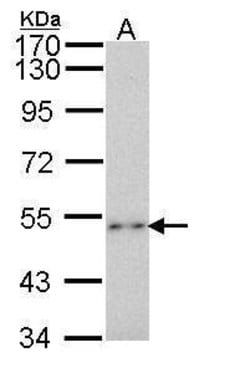
- Recommended positive controls: A431, H1299
- Predicted reactivity: Rhesus Monkey (100%)
- Store product as a concentrated solution
- Centrifuge briefly prior to opening the vial
- Adrenergic receptors (ARs) are members of the 7-transmembrane domain G-protein-coupled receptor superfamily that bind the endogenous catecholamines epinephrine and norepinephrine
- Pharmacological, structural, and molecular cloning data indicate significant heterogeneity within this receptor family
- Nine receptor subtypes have been identified thus far including three alpha-1 AR subtypes (1A/D, 1B, and 1C), three alpha-2 ARs (2A, 2B, and 2C), and three beta AR subtypes (1, 2, and 3)
- ARs participate in either the onset or maintenance of several disease states including hypertension, cardiac dysfunction (congestive heart failure, ischemia, arrhythmias), diabetes, glaucoma, depression, and impotence
- BARs participate in diverse processes including development, behavior, cardiac function, smooth muscle tone, and metabolism
- In gene-knockout experiments, the majority of mice that lack the B1AR gene die prenatally and those that do survive until adulthood display abnormal cardiac function
- Other studies have shown that the direct regulation of cardiac B1AR density by thyroid hormones occurs at the transcriptional level and is modulated by the catecholamine sensitive-adenylyl cyclase system
- Evidence for the effects of cAMP on B1AR regulation has come from a study of members of the cAMP response element (CRE) modulator (CREM) family of transcription factors in transformed cell lines.