EphB4 Polyclonal Antibody, Invitrogen™
Manufacturer: Thermo Scientific
Select a Size
| Pack Size | SKU | Availability | Price |
|---|---|---|---|
| Each of 1 | PIPA528859-Each-of-1 | In Stock | ₹ 52,332.00 |
PIPA528859 - Each of 1
In Stock
Quantity
1
Base Price: ₹ 52,332.00
GST (18%): ₹ 9,419.76
Total Price: ₹ 61,751.76
Antigen
EphB4
Classification
Polyclonal
Conjugate
Unconjugated
Gene
EPHB4
Gene Alias
AI042935; Developmental kinase 2; EPH receptor B4; Ephb4; ephrin receptor EphB4; ephrin type-B receptor 4; Hepatoma transmembrane kinase; HTK; Mdk2; mDK-2; MYK1; soluble EPHB4 variant 1; soluble EPHB4 variant 2; soluble EPHB4 variant 3; TYRO11; Tyrosine kinase MYK-1; tyrosine-protein kinase receptor HTK; tyrosine-protein kinase TYRO11
Host Species
Rabbit
Purification Method
Antigen affinity chromatography
Regulatory Status
RUO
Gene ID (Entrez)
2050
Content And Storage
Store at 4°C short term. For long term storage, store at -20°C, avoiding freeze/thaw cycles.
Form
Liquid
Applications
Immunocytochemistry, Western Blot
Concentration
0.63 mg/mL
Formulation
0.1M tris glycine with 10% glycerol and 0.01% thimerosal; pH 7
Gene Accession No.
P54760
Gene Symbols
EPHB4
Immunogen
Recombinant fragment corresponding to a region within amino acids 1 and 229 of Human Eph receptor B4
Quantity
100 μL
Primary or Secondary
Primary
Target Species
Human
Product Type
Antibody
Isotype
IgG
Related Products

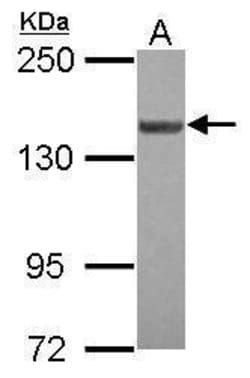
Description
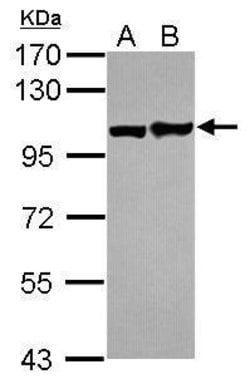
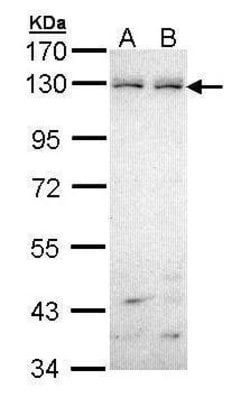
- Recommended positive controls: 293T, A431, Jurkat, Raji
- Predicted reactivity: Mouse (92%), Bovine (96%)
- Store product as a concentrated solution
- Centrifuge briefly prior to opening the vial
- EPHB4 is a receptor tyrosine kinase that belongs to the ephrin receptor family
- Members of the Eph family of kinases play important roles in diverse biological processes including nervous system development, angiogenesis and neural synapsis formation and maturation
- Based on their structures and sequence relationships, ephrins are divided into the ephrin-A (EFNA) class, which are anchored to the membrane by a glycosylphosphatidylinositol linkage, and the ephrin-B (EFNB) class, which are transmembrane proteins
- The Eph family of receptors are divided into 2 groups based on the similarity of their extracellular domain sequences and their affinities for binding ephrin-A and ephrin-B ligands
- Ephrin receptors make up the largest subgroup of the receptor tyrosine kinase (RTK) family
- The protein encoded by EphB4 binds to ephrin-B2 and plays an essential role in vascular development.