GSTM5 Polyclonal Antibody, Invitrogen™
Manufacturer: Thermo Scientific
Select a Size
| Pack Size | SKU | Availability | Price |
|---|---|---|---|
| Each of 1 | PIPA528892-Each-of-1 | In Stock | ₹ 48,015.50 |
PIPA528892 - Each of 1
In Stock
Quantity
1
Base Price: ₹ 48,015.50
GST (18%): ₹ 8,642.79
Total Price: ₹ 56,658.29
Antigen
GSTM5
Classification
Polyclonal
Conjugate
Unconjugated
Gene
GSTM5
Gene Alias
fibrous sheath component 2; Fsc2; glutathione S-alkyltransferase M5; glutathione S-aralkyltransferase M5; glutathione S-aryltransferase M5; glutathione S-transferase M5; glutathione S-transferase Mu 5; glutathione S-transferase, mu 5; glutathione-S-transferase, mu 5; GST class-mu 5; Gstm3; GSTM5; GSTM5-5; GTM5; S-(hydroxyalkyl)glutathione lyase M5
Host Species
Rabbit
Purification Method
Antigen affinity chromatography
Regulatory Status
RUO
Gene ID (Entrez)
14866, 2949, 64352
Content And Storage
Store at 4°C short term. For long term storage, store at -20°C, avoiding freeze/thaw cycles.
Form
Liquid
Applications
Immunocytochemistry, Immunohistochemistry (Paraffin), Western Blot
Concentration
1 mg/mL
Formulation
0.1M tris glycine with 10% glycerol and 0.01% thimerosal; pH 7
Gene Accession No.
P46439, P48774, Q9Z1B2
Gene Symbols
GSTM5
Immunogen
Full length human GSTM5 Recombinant protein.
Quantity
100 μL
Primary or Secondary
Primary
Target Species
Human, Mouse, Rat
Product Type
Antibody
Isotype
IgG
Related Products

Description
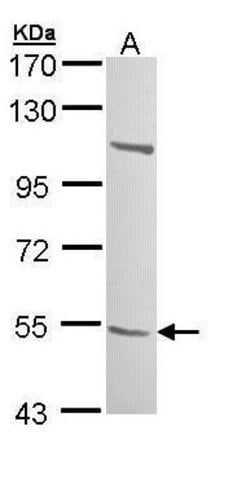
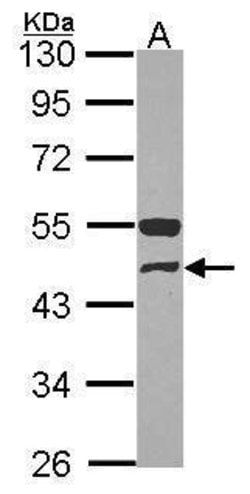
- Recommended positive controls: mouse testis, rat testis
- Store product as a concentrated solution
- Centrifuge briefly prior to opening the vial
- Cytosolic and membrane-bound forms of glutathione S-transferase are encoded by two distinct supergene families
- At present, eight distinct classes of the soluble cytoplasmic mammalian glutathione S-transferases have been identified: alpha, kappa, mu, omega, pi, sigma, theta and zeta
- This gene encodes a glutathione S-transferase that belongs to the mu class
- The mu class of enzymes functions in the detoxification of electrophilic compounds, including carcinogens, therapeutic drugs, environmental toxins and products of oxidative stress, by conjugation with glutathione
- The genes encoding the mu class of enzymes are organized in a gene cluster on chromosome 1p13.3 and are known to be highly polymorphic
- These genetic variations can change an individual's susceptibility to carcinogens and toxins as well as affect the toxicity and efficacy of certain drugs
- Diversification of these genes has occurred in regions encoding substrate-binding domains, as well as in tissue expression patterns, to accommodate an increasing number of foreign compounds.