POLI Polyclonal Antibody, Invitrogen™
Manufacturer: Thermo Scientific
Select a Size
| Pack Size | SKU | Availability | Price |
|---|---|---|---|
| Each of 1 | PIPA529534-Each-of-1 | In Stock | ₹ 46,146.50 |
PIPA529534 - Each of 1
In Stock
Quantity
1
Base Price: ₹ 46,146.50
GST (18%): ₹ 8,306.37
Total Price: ₹ 54,452.87
Antigen
POLI
Classification
Polyclonal
Conjugate
Unconjugated
Gene
Poli
Gene Alias
DNA polymerase iota; eta2; Poli; polymerase (DNA directed) iota; polymerase (DNA directed), iota; polymerase (DNA) iota; polymerase (DNA-directed), iota; RAD 30B; RAD30; RAD30 homolog B; RAD30B; RAD3OB
Host Species
Rabbit
Purification Method
Antigen affinity chromatography
Regulatory Status
RUO
Gene ID (Entrez)
11201
Content And Storage
Store at 4°C short term. For long term storage, store at -20°C, avoiding freeze/thaw cycles.
Form
Liquid
Applications
Western Blot
Concentration
0.85 mg/mL
Formulation
PBS with 1% BSA, 20% glycerol and 0.01% thimerosal; pH 7
Gene Accession No.
Q9UNA4
Gene Symbols
Poli
Immunogen
Recombinant fragment corresponding to a region within amino acids 323 and 590 of Human DNA polymerase iota
Quantity
100 μL
Primary or Secondary
Primary
Target Species
Human
Product Type
Antibody
Isotype
IgG
Related Products
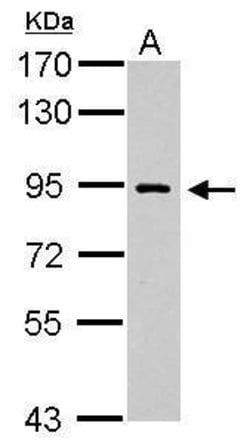
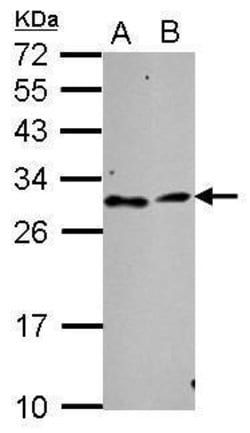
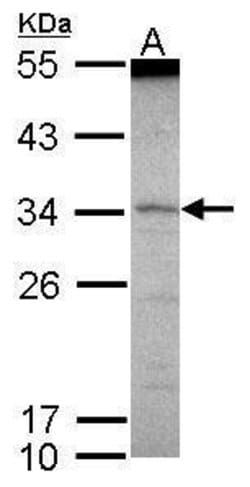
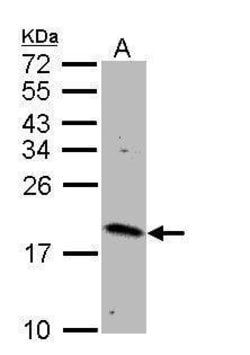

Description
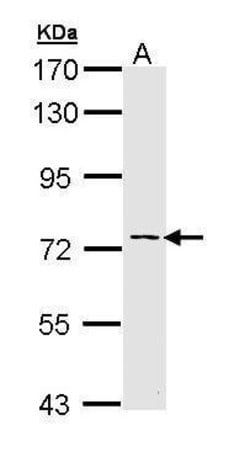
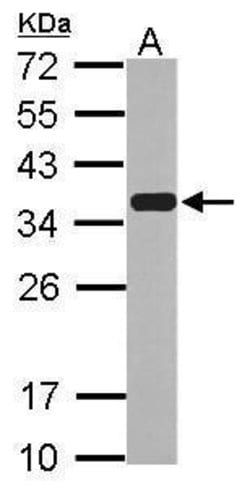
- Recommended positive controls: PC-3, SK-N-SH
- Predicted reactivity: Chimpanzee (98%), Bovine (85%)
- Store product as a concentrated solution
- Centrifuge briefly prior to opening the vial
- Error-prone DNA polymerase specifically involved in DNA repair
- Plays an important role in translesion synthesis, where the normal high-fidelity DNA polymerases cannot proceed and DNA synthesis stalls
- Favors Hoogsteen base-pairing in the active site
- Inserts the correct base with high-fidelity opposite an adenosine template
- Exhibits low fidelity and efficiency opposite a thymidine template, where it will preferentially insert guanosine
- May play a role in hypermutation of immunoglobulin genes
- Forms a Schiff base with 5'-deoxyribose phosphate at abasic sites, but may not have lyase activity.