CRALBP Polyclonal Antibody, Invitrogen™
Manufacturer: Thermo Scientific
Select a Size
| Pack Size | SKU | Availability | Price |
|---|---|---|---|
| Each of 1 | PIPA529759-Each-of-1 | In Stock | ₹ 52,688.00 |
PIPA529759 - Each of 1
In Stock
Quantity
1
Base Price: ₹ 52,688.00
GST (18%): ₹ 9,483.84
Total Price: ₹ 62,171.84
Antigen
CRALBP
Classification
Polyclonal
Conjugate
Unconjugated
Gene
RLBP1
Gene Alias
3110056M11Rik; cellular retinaldehyde-binding protein; cellular retinaldehyde-binding protein-1; CRALBP; retinaldehyde binding protein 1; retinaldehyde-binding protein 1; retinaldehyde-binding protein precursor; Rlbp1
Host Species
Rabbit
Purification Method
Antigen affinity chromatography
Regulatory Status
RUO
Gene ID (Entrez)
19771, 6017
Content And Storage
Store at 4°C short term. For long term storage, store at -20°C, avoiding freeze/thaw cycles.
Form
Liquid
Applications
Immunocytochemistry, Western Blot
Concentration
1.41 mg/mL
Formulation
PBS with 20% glycerol and 0.025% ProClin 300; pH 7
Gene Accession No.
P12271, Q9Z275
Gene Symbols
RLBP1
Immunogen
Recombinant fragment corresponding to a region within amino acids 74 and 311 of Human CRALBP
Quantity
100 μL
Primary or Secondary
Primary
Target Species
Human, Mouse
Product Type
Antibody
Isotype
IgG
Related Products

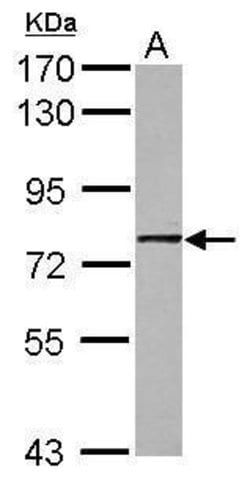
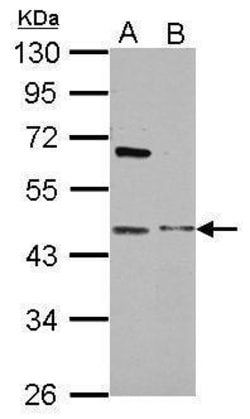

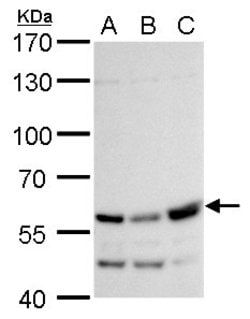
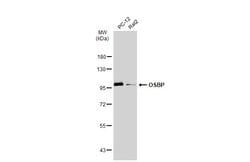

Description
- Recommended positive controls: HepG2, mouse eye
- Predicted reactivity: Mouse (91%), Rat (91%), Xenopus laevis (82%), Chicken (86%), Bovine (92%)
- Store product as a concentrated solution
- Centrifuge briefly prior to opening the vial
- Cellular retinaldehyde-binding protein (CRALBP) plays an important role in the regeneration of 11-cis-retinal for use in rod visual pigments such as opsin and rhodopsin
- Once 11-cis-retinal is photoisomerized in the rod outer segment, it is converted to all-trans-retinal and further modified into all-trans-retinol
- All-trans-retinol then diffuses into the retinal pigment epithelium (RPE) to be converted back to 11-cis-retinol and further oxidized into 11-cis-retinal (both by CRALBP)
- Genetic mutations involving CRALBP's lack of function have been linked to visual disease such as bothnia dystrophy, retinitis punctata albescens, retina pigmentosa, and Newfoundland rod-cone dystrophy
- The presence of CRALBP serves as a marker for RPE and Muller glial cells of the retina.