Presenilin 1 Polyclonal Antibody, Invitrogen™
Manufacturer: Thermo Scientific
Select a Size
| Pack Size | SKU | Availability | Price |
|---|---|---|---|
| Each of 1 | PIPA530585-Each-of-1 | In Stock | ₹ 48,905.50 |
PIPA530585 - Each of 1
In Stock
Quantity
1
Base Price: ₹ 48,905.50
GST (18%): ₹ 8,802.99
Total Price: ₹ 57,708.49
Antigen
Presenilin 1
Classification
Polyclonal
Conjugate
Unconjugated
Gene
PSEN1
Gene Alias
AD3; Ad3h; Alzheimer Disease 3; FAD; Minilin; presenilin 1; presenilin 1 (Alzheimer disease 3); presenilin1; presenilin-1; Presenilin-1 CTF subunit; Presenilin-1 CTF12; Presenilin-1 NTF subunit; Protein S182; PS1; PS-1; PS1-CTF12; PSEN1; Psnl1; S182; S182 protein; Senilin 1
Host Species
Rabbit
Purification Method
Antigen affinity chromatography
Regulatory Status
RUO
Gene ID (Entrez)
19164, 5663
Content And Storage
Store at 4°C short term. For long term storage, store at -20°C, avoiding freeze/thaw cycles.
Form
Liquid
Applications
Immunocytochemistry, Immunohistochemistry (Paraffin), Western Blot
Concentration
0.53 mg/mL
Formulation
0.1M tris glycine with 10% glycerol and 0.01% thimerosal; pH 7
Gene Accession No.
P49768, P49769
Gene Symbols
PSEN1
Immunogen
Synthetic peptide corresponding to a region within amino acids 257 and 352 of Human Presenilin 1
Quantity
100 μL
Primary or Secondary
Primary
Target Species
Human, Mouse
Product Type
Antibody
Isotype
IgG
Related Products




Description
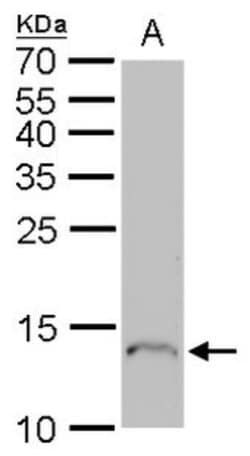
- Recommended positive controls: HeLa
- Predicted reactivity: Rhesus Monkey (100%)
- Store product as a concentrated solution
- Centrifuge briefly prior to opening the vial
- Presenilin1 was initially identified a marker of susceptibility to early-onset Alzheimer's disease
- In addition to PEN2, nicastrin and APH-1, Presenilin1 forms the -gamma-secretase protein complex, a membrane-bound aspartyl protease that can cleave certain proteins at peptide bonds buried within the hydrophobic environment of the lipid bilayer
- This cleavage is responsible for a key step in signaling from several cell-surface receptors and is thought to be required for the generation of the neurotoxic amyloid peptides that are central to the pathogenesis of Alzheimer's disease
- Like the tumor necrosis factor-alpha-converting enzyme (TACE) and the beta-site cleavage enzyme (BACE) protease families, -gamma-secretase will cleave the amyloid precursor protein (APP), but within the intramembrane region of APP, resulting in either the non-toxic p3 (from the alpha and -gamma cleavage site) or the toxic Abeta amyloid peptide (from the beta and -gamma cleavage site)
- It is thought that accumulation of the Abeta peptide is the precursor to Alzheimer's disease
- Multiple isoforms of presenilin1 are known to exist.