PTGER2 Polyclonal Antibody, Invitrogen™
Manufacturer: Thermo Scientific
Select a Size
| Pack Size | SKU | Availability | Price |
|---|---|---|---|
| Each of 1 | PIPA532997-Each-of-1 | In Stock | ₹ 46,591.50 |
PIPA532997 - Each of 1
In Stock
Quantity
1
Base Price: ₹ 46,591.50
GST (18%): ₹ 8,386.47
Total Price: ₹ 54,977.97
Antigen
PTGER2
Classification
Polyclonal
Conjugate
Unconjugated
Gene
PTGER2
Gene Alias
EP2; EP2 receptor; PGE receptor EP2 subtype; PGE receptor, EP2 subtype; PGE2 receptor EP2 subtype; Pge2-r ep2; prostaglandin E receptor 2; prostaglandin E receptor 2 (EP2 subtype); prostaglandin E receptor 2 (subtype EP2); prostaglandin E receptor 2 (subtype EP2), 53kD; prostaglandin E receptor 2 (subtype EP2), 53kDa; prostaglandin E receptor EP2 subtype; prostaglandin E receptor subtype EP2; prostaglandin E2 receptor EP2; prostaglandin E2 receptor EP2 subtype; prostaglandin E2 receptor EP2 subtype pseudogene; prostaglandin E2 receptor type 2; prostanoid EP2 receptor; Ptger2; Ptgerep2; Ptger-ep2
Host Species
Rabbit
Purification Method
Antigen affinity chromatography
Regulatory Status
RUO
Gene ID (Entrez)
5732
Content And Storage
Store at 4°C short term. For long term storage, store at -20°C, avoiding freeze/thaw cycles.
Form
Liquid
Applications
ELISA, Immunohistochemistry (Paraffin)
Concentration
1 mg/mL
Formulation
PBS with 0.1% sodium azide
Gene Accession No.
P43116
Gene Symbols
PTGER2
Immunogen
Synthetic 16 amino acid peptide from C-terminal cytoplasmic domain of human EP2.
Quantity
50 μg
Primary or Secondary
Primary
Target Species
Human, Non-human Primate
Product Type
Antibody
Isotype
IgG
Related Products
Description
- Percent identity with other species by BLAST analysis: Human, Gorilla, Gibbon, Marmoset (100%); Monkey, Bovine (88%); Mouse, Bat, Dog, Panda, Pig (81%)
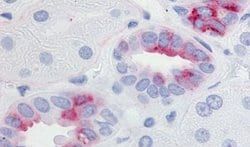
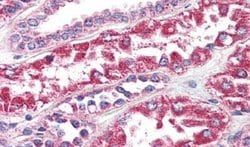
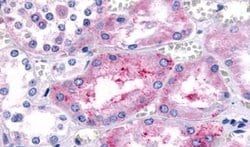
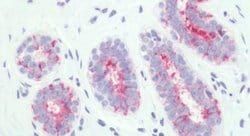
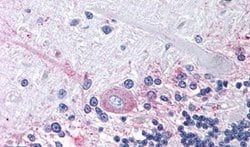
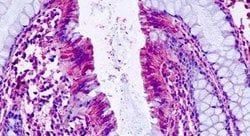
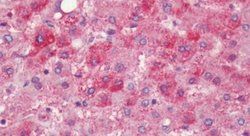
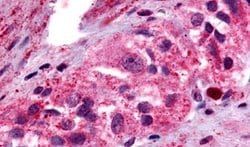
- For IHC(P), use heat induced antigen retrieval in pH 6.0 citrate buffer
- After incubation with the primary antibody, slides were incubated with biotinylated secondary antibody, followed by alkaline phosphatase-streptavidin and chromogen
- Prostaglandins are produced by the metabolism of arachidonic acid
- Prostaglandin E2 is one of the five physiologically significant prostanoids known
- Its wide spectrum of physiologic and pharmacologic effects in various tissues is mediated through binding to the Prostaglandin E2 receptors (EP1, EP2, EP3 & EP4)
- These include effects on the immune, endocrine, cardiovascular, renal and reproductive systems as well as smooth muscle
- It is also one of the most abundant of the prostanoid family in the brain where it plays an important role in many neural functions, particularly in newborn babies, and as a mediator of inflammation
- PGE-2 signals through a family of G-protein coupled receptors known as EP receptors
- There are 4 subtypes of EP receptors, known as EP1, EP2, EP3 and EP4
- EP2 receptors are 358 amino acid proteins with a short third intracellular loop
- EP2 receptors stimulate adenylyl cyclase by their coupling to Gs and do not undergo PGE-2-induced internalization
- The EP2 receptors is involved with the contration and relaxation of smooth muscle tissue
- These receptors are mainly localized in lung and placental tissues and in smooth muscle.