CALCRL Polyclonal Antibody, Invitrogen™
Manufacturer: Thermo Scientific
Select a Size
| Pack Size | SKU | Availability | Price |
|---|---|---|---|
| Each of 1 | PIPA533382-Each-of-1 | In Stock | ₹ 46,591.50 |
PIPA533382 - Each of 1
In Stock
Quantity
1
Base Price: ₹ 46,591.50
GST (18%): ₹ 8,386.47
Total Price: ₹ 54,977.97
Antigen
CALCRL
Classification
Polyclonal
Conjugate
Unconjugated
Gene
CALCRL
Gene Alias
AV071593; Calcitonin gene-related peptide type 1 receptor; calcitonin receptor like receptor; calcitonin receptor-like; calcitonin receptor-like receptor; CALCRL; CGRP receptor; CGRP type 1 receptor; Cgrp1 receptor; CGRPR; CLR; CRLR; RATCRLR; RNCLR
Host Species
Rabbit
Purification Method
Antigen affinity chromatography
Regulatory Status
RUO
Gene ID (Entrez)
100054281, 100354426, 100753229, 10203, 25029, 397172, 488438, 527140
Content And Storage
Store at 4°C short term. For long term storage, store at -20°C, avoiding freeze/thaw cycles.
Form
Liquid
Applications
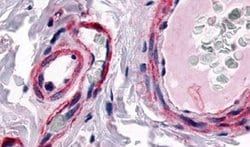
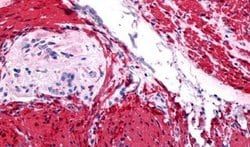
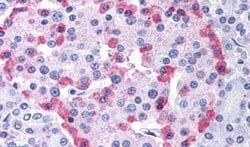
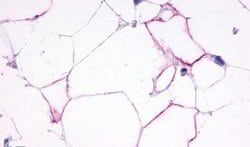
Immunohistochemistry (Paraffin)
Concentration
1 mg/mL
Formulation
PBS with 0.1% sodium azide
Gene Accession No.
A6QP74, Q16602, Q63118, Q8WN93
Gene Symbols
CALCRL
Immunogen
Synthetic 16 amino acid peptide from 3rd cytoplasmic domain of human CALCRL.
Quantity
50 μg
Primary or Secondary
Primary
Target Species
Bovine, Canine, Equine, Hamster, Human, Non-human Primate, Porcine, Rabbit, Rat, X. laevis
Product Type
Antibody
Isotype
IgG
Related Products
Description
- CRLR is a receptor for calcitonin gene-related peptide type 1
- The activity of CRLR is mediated by G proteins which activate adenylyl cyclase
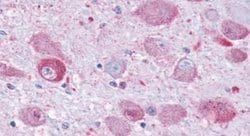
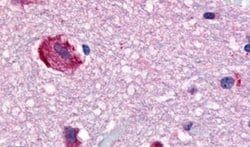
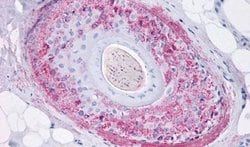
- CRLR expression has been reported in brain, lung, blood vessel, liver, and intestinal tract
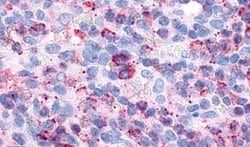
- ESTs have been isolated from B-cell/lung/testis, bome marrow, embryo, lung and synovium libraries.