MRGPRX2 Polyclonal Antibody, Invitrogen™
Manufacturer: Thermo Scientific
Select a Size
| Pack Size | SKU | Availability | Price |
|---|---|---|---|
| Each of 1 | PIPA533951-Each-of-1 | In Stock | ₹ 49,439.50 |
PIPA533951 - Each of 1
In Stock
Quantity
1
Base Price: ₹ 49,439.50
GST (18%): ₹ 8,899.11
Total Price: ₹ 58,338.61
Antigen
MRGPRX2
Classification
Polyclonal
Conjugate
Unconjugated
Gene
MRGPRX2
Gene Alias
G protein-coupled receptor MRGX2; G370024M05Rik; MAS related GPR family member X2; Mas-related G protein-coupled receptor G3; MAS-related GPR, member B10; MAS-related GPR, member X2; mas-related G-protein coupled receptor member B10; Mas-related G-protein coupled receptor member X2; MGRG3; MrgB10; Mrgprb10; Mrgprx2; MRGX2
Host Species
Rabbit
Purification Method
Antigen affinity chromatography
Regulatory Status
RUO
Gene ID (Entrez)
117194
Content And Storage
Store at 4°C short term. For long term storage, store at -20°C, avoiding freeze/thaw cycles.
Form
Liquid
Applications
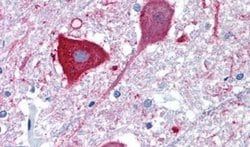
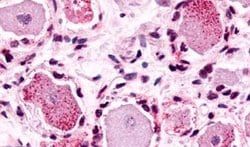
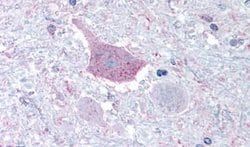
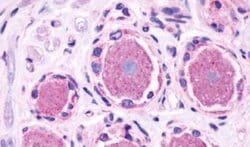
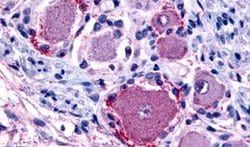
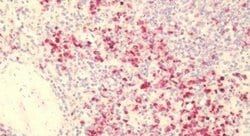
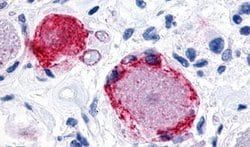
Immunohistochemistry (Paraffin)
Concentration
1 mg/mL
Formulation
PBS with 0.1% sodium azide
Gene Accession No.
Q96LB1
Gene Symbols
MRGPRX2
Immunogen
Synthetic 14 amino acid peptide from 2nd extracellular domain of human MRGPRX2 / MRGX2.
Quantity
50 μg
Primary or Secondary
Primary
Target Species
Human, Non-human Primate
Product Type
Antibody
Isotype
IgG
Related Products

Description
- Percent identity with other species by BLAST analysis: Human, Orangutan, Monkey (100%) Chimpanzee, Gorilla, Gibbon, Marmoset (86%)
- Orphan receptor
- Probably involved in the function of nociceptive neurons
- May regulate nociceptor function and/or development, including the sensation or modulation of pain
- Cortistatin-14 seems to be a high potency ligand at this receptor
- Cortistatin has several biological functions including roles in sleep regulation locomotor activity, and cortical function
- In receptor-expressing cells, cortistatin-stimulated increases in intracellular Ca(2+) but had no effect on basal or forskolin-stimulated cAMP levels, suggesting that this receptor is G(q)-coupled
- Has a limited expression profile, both peripheral and within the central nervous system, with highest levels in dorsal root ganglion.