ASB7 Polyclonal Antibody, Invitrogen™
Manufacturer: Thermo Scientific
Select a Size
| Pack Size | SKU | Availability | Price |
|---|---|---|---|
| Each of 1 | PIPA551888-Each-of-1 | In Stock | ₹ 52,332.00 |
PIPA551888 - Each of 1
In Stock
Quantity
1
Base Price: ₹ 52,332.00
GST (18%): ₹ 9,419.76
Total Price: ₹ 61,751.76
Antigen
ASB7
Classification
Polyclonal
Conjugate
Unconjugated
Gene
ASB7
Gene Alias
AI449039; ankyrin repeat and SOCS box containing 7; ankyrin repeat and SOCS box protein 7; ankyrin repeat and SOCS box-containing 7; ankyrin repeat and SOCS box-containing protein 7; ASB7; Asb-7; D030055C23Rik
Host Species
Rabbit
Purification Method
Antigen affinity chromatography
Regulatory Status
RUO
Gene ID (Entrez)
140460
Content And Storage
Store at 4°C short term. For long term storage, store at -20°C, avoiding freeze/thaw cycles.
Form
Liquid
Applications
Immunocytochemistry, Immunohistochemistry, Western Blot
Concentration
0.1 mg/mL
Formulation
PBS with 40% glycerol and 0.02% sodium azide; pH 7.2
Gene Accession No.
Q9H672
Gene Symbols
ASB7
Immunogen
Recombinant protein corresponding to Human ASB7
Quantity
100 μL
Primary or Secondary
Primary
Target Species
Human
Product Type
Antibody
Isotype
IgG
Related Products
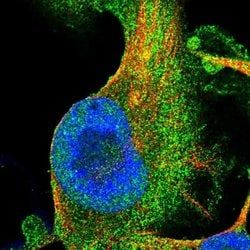

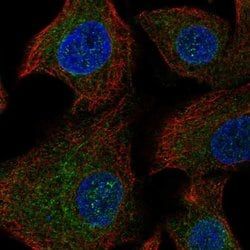
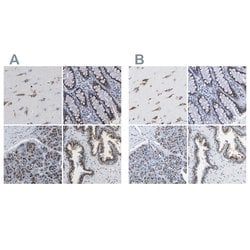
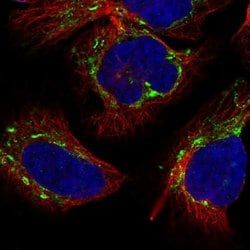


Description
- Immunogen sequence: HHHCRRNPEL QEELQIQAAV AAGDVHTVRK MLEQGYSPNG RDANGWTLLH FSAARGKERC VRVFLEHGAD PTVKDLIGGF TALHYAAMHG RARIARLMLE SEYRSDIINA KSNDGWTPLH VAAHYGRDSF VRLLLEFKAE VDPLSDK Highest antigen sequence identity to the following orthologs: Mouse - 100%, Rat - 100%
- The protein encoded by this gene belongs to a family of ankyrin repeat proteins that, along with four other protein families, contains a C-terminal SOCS box motif
- Growing evidence suggests that the SOCS box acts as a bridge between specific substrate-binding domains and the more generic proteins that comprise a large family of E3 ubiquitin protein ligases
- In this way, SOCS box containing proteins may regulate protein turnover by targeting proteins for polyubiquination and, therefore, for proteasome-mediated degradation
- Two alternative transcripts encoding different isoforms have been described.