PTK9 Polyclonal Antibody, Invitrogen™
Manufacturer: Thermo Scientific
Select a Size
| Pack Size | SKU | Availability | Price |
|---|---|---|---|
| Each of 1 | PIPA553729-Each-of-1 | In Stock | ₹ 48,905.50 |
PIPA553729 - Each of 1
In Stock
Quantity
1
Base Price: ₹ 48,905.50
GST (18%): ₹ 8,802.99
Total Price: ₹ 57,708.49
Antigen
PTK9
Classification
Polyclonal
Conjugate
Unconjugated
Gene
TWF1
Gene Alias
A6; A6 protein tyrosine kinase; actin monomer-binding protein; protein A6; Protein tyrosine kinase 9; PTK9; PTK9 protein tyrosine kinase 9; TWF1; twinfilin; twinfilin actin binding protein 1; twinfilin actin-binding protein 1; twinfilin, actin-binding protein, homolog 1; twinfilin, actin-binding protein, homolog 1 (Drosophila); twinfilin-1
Host Species
Rabbit
Purification Method
Antigen affinity chromatography
Regulatory Status
RUO
Gene ID (Entrez)
19230, 315265, 5756
Content And Storage
Store at 4°C short term. For long term storage, store at -20°C, avoiding freeze/thaw cycles.
Form
Liquid
Applications
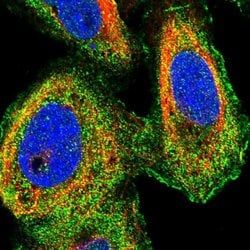
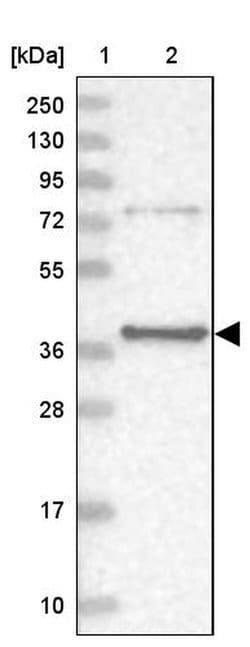
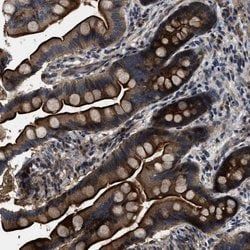
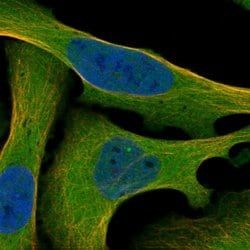
Immunocytochemistry, Immunohistochemistry, Western Blot
Concentration
0.1 mg/mL
Formulation
PBS with 40% glycerol and 0.02% sodium azide; pH 7.2
Gene Accession No.
Q12792, Q5RJR2, Q91YR1
Gene Symbols
TWF1
Immunogen
Recombinant protein corresponding to Human PTK9
Quantity
100 μL
Primary or Secondary
Primary
Target Species
Human, Mouse, Rat
Product Type
Antibody
Isotype
IgG
Related Products

Description
- Immunogen sequence: AEEELRQIKI NEVQTDVGVD TKHQTLQGVA FPISREAFQA LEKLNNRQLN YVQLEIDIKN EIIILANTTN TELKDLPKRI PKDSARYHFF LYKHSHEGDY Highest antigen sequence identity to the following orthologs: Mouse - 92%, Rat - 93%
- This gene encodes twinfilin, an actin monomer-binding protein conserved from yeast to mammals
- Studies of the mouse counterpart suggest that this protein may be an actin monomer-binding protein, and its localization to cortical G-actin-rich structures may be regulated by the small GTPase RAC1.