GLTSCR2 Polyclonal Antibody, Invitrogen™
Manufacturer: Thermo Scientific
Select a Size
| Pack Size | SKU | Availability | Price |
|---|---|---|---|
| Each of 1 | PIPA553888-Each-of-1 | In Stock | ₹ 49,439.50 |
PIPA553888 - Each of 1
In Stock
Quantity
1
Base Price: ₹ 49,439.50
GST (18%): ₹ 8,899.11
Total Price: ₹ 58,338.61
Antigen
GLTSCR2
Classification
Polyclonal
Conjugate
Unconjugated
Gene
NOP53
Gene Alias
5330430H08Rik; 9430097C02Rik; AU041936; AW536441; glioma tumor suppressor candidate region gene 2; glioma tumor suppressor candidate region gene 2 protein; GLT; GLTSCR2; LOW QUALITY PROTEIN: glioma tumor suppressor candidate region gene 2 protein; NOP53; NOP53 ribosome biogenesis factor; p60; PICT1; PICT-1; preS1 binding protein; PreS1-binding protein; Protein interacting with carboxyl terminus 1; R74911; Ribosome biogenesis protein NOP53
Host Species
Rabbit
Purification Method
Antigen affinity chromatography
Regulatory Status
RUO
Gene ID (Entrez)
29997
Content And Storage
Store at 4°C short term. For long term storage, store at -20°C, avoiding freeze/thaw cycles.
Form
Liquid
Applications
Immunocytochemistry, Immunohistochemistry
Concentration
0.1 mg/mL
Formulation
PBS with 40% glycerol and 0.02% sodium azide; pH 7.2
Gene Accession No.
Q9NZM5
Gene Symbols
NOP53
Immunogen
Recombinant protein corresponding to Human GLTSCR2
Quantity
100 μL
Primary or Secondary
Primary
Target Species
Human
Product Type
Antibody
Isotype
IgG
Related Products
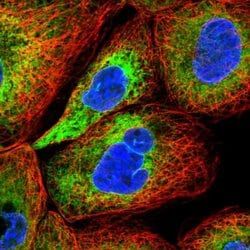

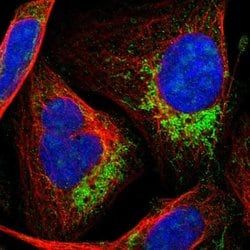

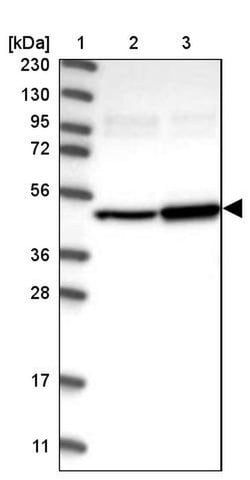
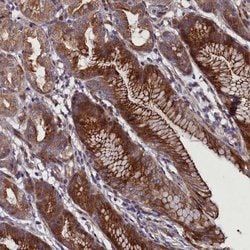

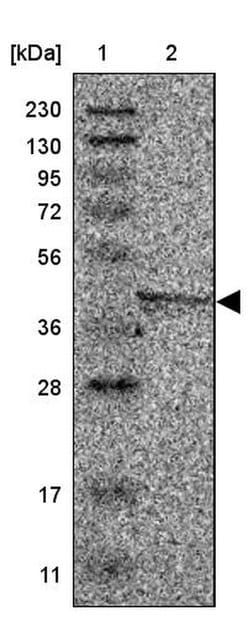
Description
- Immunogen sequence: REAEADKPRR LGRLKYQAPD IDVQLSSELT DSLRTLKPEG NILRDRFKSF QRRNMIEPRE RAKFKRKYKV KLVEKRAFRE IQL Highest antigen sequence identity to the following orthologs: Mouse - 93%, Rat - 95%
- Nucleolar protein which is involved in the integration of the 5S RNP into the ribosomal large subunit during ribosome biogenesis
- In ribosome biogenesis, may also play a role in rRNA transcription
- Also functions as a nucleolar sensor that regulates the activation of p53/TP53 in response to ribosome biogenesis perturbation, DNA damage and other stress conditions
- DNA damage or perturbation of ribosome biogenesis disrupt the interaction between NOP53 and RPL11 allowing RPL11 transport to the nucleoplasm where it can inhibit MDM2 and allow p53/TP53 activation
- It may also positively regulate the function of p53/TP53 in cell cycle arrest and apoptosis through direct interaction, preventing its MDM2-dependent ubiquitin-mediated proteasomal degradation
- Originally identified as a tumor suppressor, it may also play a role in cell proliferation and apoptosis by positively regulating the stability of PTEN, thereby antagonizing the PI3K-AKT/PKB signaling pathway
- May also inhibit cell proliferation and increase apoptosis through its interaction with NF2
- May negatively regulate NPM1 by regulating its nucleoplasmic localization, oligomerization and ubiquitin-mediated proteasomal degradation
- Thereby, may prevent NPM1 interaction with MYC and negatively regulate transcription mediated by the MYC-NPM1 complex
- May also regulate cellular aerobic respiration
- In the cellular response to viral infection, may play a role in the attenuation of interferon-beta through the inhibition of DDX58/RIG-1.