PIPA558696
FUOM Polyclonal Antibody, Invitrogen™
Manufacturer: Thermo Scientific
Select a Size
| Pack Size | SKU | Availability | Price |
|---|---|---|---|
| Each of 1 | PIPA558696-Each-of-1 | In Stock | ₹ 48,905.50 |
PIPA558696 - Each of 1
In Stock
Quantity
1
Base Price: ₹ 48,905.50
GST (18%): ₹ 8,802.99
Total Price: ₹ 57,708.49
Antigen
FUOM
Classification
Polyclonal
Conjugate
Unconjugated
Gene
FUOM
Gene Alias
C10orf125; FucM; Fucose mutarotase; FUCU; FUOM; protein fucU homolog
Host Species
Rabbit
Purification Method
Antigen affinity chromatography
Regulatory Status
RUO
Gene ID (Entrez)
282969
Content And Storage
Store at 4°C short term. For long term storage, store at -20°C, avoiding freeze/thaw cycles.
Form
Liquid
Applications
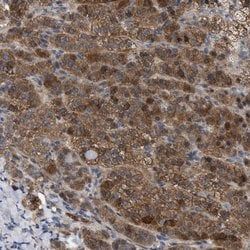
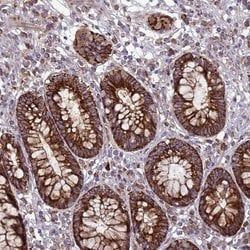
Immunohistochemistry
Concentration
0.3 mg/mL
Formulation
PBS with 40% glycerol and 0.02% sodium azide; pH 7.2
Gene Accession No.
A2VDF0
Gene Symbols
FUOM
Immunogen
Recombinant protein corresponding to Human FUOM
Quantity
100 μL
Primary or Secondary
Primary
Target Species
Human
Product Type
Antibody
Isotype
IgG
Related Products




Description
- Immunogen sequence: MVALKGVPAL LSPELLYALA RMGHGDEIVL ADLNFPASSI CQCGPMEIRA DGLGIPQLLE AVL Highest antigen sequence identity to the following orthologs: Mouse - 87%, Rat - 86%
- Involved in the interconversion between alpha- and beta-L-fucoses
- L-Fucose (6-deoxy-L-galactose) exists as alpha-L-fucose (29.5%) and beta-L-fucose (70.5%), the beta-form is metabolized through the salvage pathway
- GDP-L-fucose formed either by the de novo or salvage pathways is transported into the endoplasmic reticulum, where it serves as a substrate for N- and O-glycosylations by fucosyltransferases
- Fucosylated structures expressed on cell surfaces or secreted in biological fluids are believed to play a critical role in cell-cell adhesion and recognition processes.