PIPA560571
RHBDD3 Polyclonal Antibody, Invitrogen™
Manufacturer: Thermo Scientific
Select a Size
| Pack Size | SKU | Availability | Price |
|---|---|---|---|
| Each of 1 | PIPA560571-Each-of-1 | In Stock | ₹ 48,905.50 |
PIPA560571 - Each of 1
In Stock
Quantity
1
Base Price: ₹ 48,905.50
GST (18%): ₹ 8,802.99
Total Price: ₹ 57,708.49
Antigen
RHBDD3
Classification
Polyclonal
Conjugate
Unconjugated
Gene
RHBDD3
Gene Alias
C22orf3; CTA-984G1.4; HS984G1A; pituitary tumor apoptosis; pituitary-derived proapoptotic; PTAG; RGD1311827; Rhbdd3; rhomboid domain containing 3; rhomboid domain-containing protein 3
Host Species
Rabbit
Purification Method
Antigen affinity chromatography
Regulatory Status
RUO
Gene ID (Entrez)
25807
Content And Storage
Store at 4°C short term. For long term storage, store at -20°C, avoiding freeze/thaw cycles.
Form
Liquid
Applications
Immunocytochemistry, Immunohistochemistry, Western Blot
Concentration
0.2 mg/mL
Formulation
PBS with 40% glycerol and 0.02% sodium azide; pH 7.2
Gene Accession No.
Q9Y3P4
Gene Symbols
RHBDD3
Immunogen
Recombinant protein corresponding to Human RHBDD3
Quantity
100 μL
Primary or Secondary
Primary
Target Species
Human
Product Type
Antibody
Isotype
IgG
Related Products
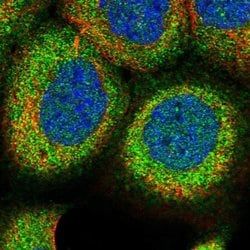
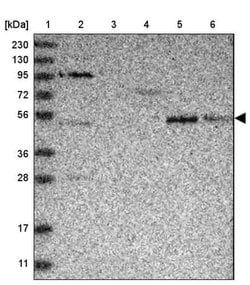
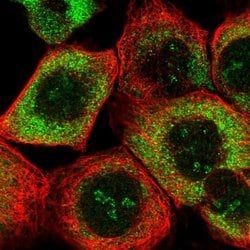
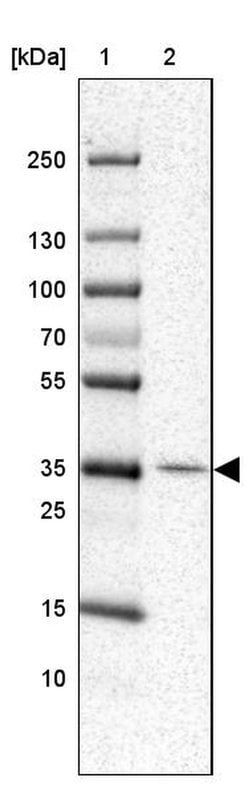

Description
- Immunogen sequence: HWEDSALPPP SLRPVQPTWE GSSEAGLDWA GASFSPGTPM WAALDEQMLQ EGIQASLLDG PAQEPQSAPW LSKSSVSSL Highest antigen sequence identity to the following orthologs: Mouse - 66%, Rat - 62%
- The Rhomboid family of proteins is made up of several widely conserved polytopic membrane serine proteases that play roles in growth and development
- RHBDD3 was initially identified as a novel pituitary tumor apoptosis gene (PTAG) whose expression was reduced in certain pituitary adenomas
- Overexpression of RHBDD3 in AtT20 cells showed an increase in apoptotic activity and caspase activation in response to bromocriptine, and apoptosis-inducing dopamine D2 analog, suggesting that reactivation of RHBDD3 in tumors may be a therapeutically useful tool
- Later experiments also showed that RHBDD3 expression is also reduced in several primary colorectal tumors, indicating that loss of RHBDD3 contributes to a blunted apoptotic response and probably predisposes cells towards malignant transformation.