KIAA1033 Polyclonal Antibody, Invitrogen™
Manufacturer: Thermo Scientific
Select a Size
| Pack Size | SKU | Availability | Price |
|---|---|---|---|
| Each of 1 | PIPA561064-Each-of-1 | In Stock | ₹ 48,905.50 |
PIPA561064 - Each of 1
In Stock
Quantity
1
Base Price: ₹ 48,905.50
GST (18%): ₹ 8,802.99
Total Price: ₹ 57,708.49
Antigen
KIAA1033
Classification
Polyclonal
Conjugate
Unconjugated
Gene
WASHC4
Gene Alias
A230046K03Rik; AA589518; Kiaa1033; mKIAA1033; MRT43; RIKEN cDNA A230046K03 gene; strumpellin and WASH-interacting protein; SWIP; WASH complex subunit 4; WASH complex subunit 7; WASH complex subunit SWIP; WASHC4
Host Species
Rabbit
Purification Method
Antigen affinity chromatography
Regulatory Status
RUO
Gene ID (Entrez)
23325
Content And Storage
Store at 4°C short term. For long term storage, store at -20°C, avoiding freeze/thaw cycles.
Form
Liquid
Applications
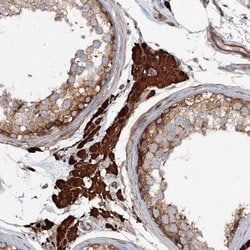
Immunocytochemistry, Immunohistochemistry
Concentration
0.05 mg/mL
Formulation
PBS with 40% glycerol and 0.02% sodium azide; pH 7.2
Gene Accession No.
Q2M389
Gene Symbols
WASHC4
Immunogen
Recombinant protein corresponding to Human KIAA1033
Quantity
100 μL
Primary or Secondary
Primary
Target Species
Human
Product Type
Antibody
Isotype
IgG
Related Products






Description
- Immunogen sequence: KVLNKVITVY AALCCEIKKL KYEAETKFYN GLLFYGEGAT DASMVEGDCQ IQMGRFISFL QELSCFVTRC YEVVMNVVHQ LAALYISNKI APKII Highest antigen sequence identity to the following orthologs: Mouse - 96%, Rat - 91%
- This gene encodes a component of the WASH complex, which functions in the intracellular transport of endosomes
- Mutations in this gene have been detected in individuals with autosomal recessive cognitive disability
- Alternative splicing results in multiple transcript variants.