UTP20 Polyclonal Antibody, Invitrogen™
Manufacturer: Thermo Scientific
Select a Size
| Pack Size | SKU | Availability | Price |
|---|---|---|---|
| Each of 1 | PIPA565554-Each-of-1 | In Stock | ₹ 49,261.50 |
PIPA565554 - Each of 1
In Stock
Quantity
1
Base Price: ₹ 49,261.50
GST (18%): ₹ 8,867.07
Total Price: ₹ 58,128.57
Antigen
UTP20
Classification
Polyclonal
Conjugate
Unconjugated
Gene
UTP20
Gene Alias
1A6/DRIM; 3830408P06Rik; AA617408; down regulated in metastasis; down-regulated in metastasis protein; DRIM; mDRIM; mDRIN; NNP73; novel nucleolar protein 73; Protein Key-1A6; RGD1560606; Small subunit processome component 20 homolog; UTP20; UTP20 small subunit (SSU) processome component; UTP20 small subunit processome component; UTP20, small subunit (SSU) processome component, homolog; UTP20, small subunit (SSU) processome component, homolog (yeast); UTP20, small subunit processome component
Host Species
Rabbit
Purification Method
Antigen affinity chromatography
Regulatory Status
RUO
Gene ID (Entrez)
27340
Content And Storage
Store at 4°C short term. For long term storage, store at -20°C, avoiding freeze/thaw cycles.
Form
Liquid
Applications
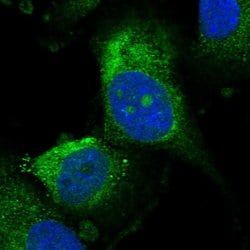
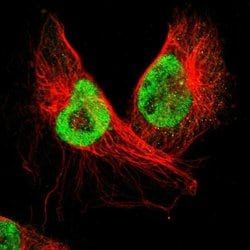
Immunocytochemistry
Concentration
0.05 mg/mL
Formulation
PBS with 40% glycerol and 0.02% sodium azide; pH 7.2
Gene Accession No.
O75691
Gene Symbols
UTP20
Immunogen
Recombinant Human UTP20
Quantity
100 μL
Primary or Secondary
Primary
Target Species
Human
Product Type
Antibody
Isotype
IgG
Related Products



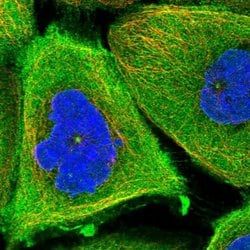
Description
- Immunogen sequence: FETLSDFESGL KYITDVVKLN AFDQRHLDDI NFDVRFETFQ TITSYIKEMQ IVDVNYLIPV MHNCFYNLEL GDMSLSDNAS MC Highest antigen sequence identity to the following orthologs - mouse 81%, rat 81%
- Isoform 1 may function as a nuclear receptor coactivator, enhancing transcription through other coactivators such as NCOA6 and CITED1
- Isoform 2, functions as a transcriptional repressor, modulating transcriptional activities of coactivators including isoform 1, NCOA6 and CITED1.