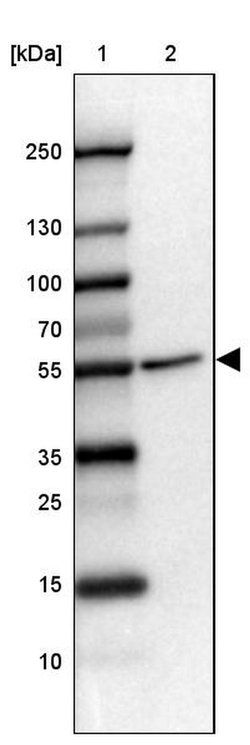
KDELR3 Polyclonal Antibody, Invitrogen™
Manufacturer: Thermo Scientific
Select a Size
| Pack Size | SKU | Availability | Price |
|---|---|---|---|
| Each of 1 | PIPA575398-Each-of-1 | In Stock | ₹ 46,502.50 |
PIPA575398 - Each of 1
In Stock
Quantity
1
Base Price: ₹ 46,502.50
GST (18%): ₹ 8,370.45
Total Price: ₹ 54,872.95
Antigen
KDELR3
Classification
Polyclonal
Conjugate
Unconjugated
Gene
KDELR3
Gene Alias
AI173274; ER lumen protein retaining receptor 3; ER lumen protein-retaining receptor 3; ERD23; ERD2L3; KDEL (Lys-Asp-Glu-Leu) endoplasmic reticulum protein retention receptor 3; KDEL endoplasmic reticulum protein retention receptor 3; KDEL receptor 3; Kdelr3
Host Species
Rabbit
Purification Method
Antigen affinity chromatography
Regulatory Status
RUO
Gene ID (Entrez)
105785, 11015, 315131
Content And Storage
Store at 4°C short term. For long term storage, store at -20°C, avoiding freeze/thaw cycles.
Form
Liquid
Applications
Immunohistochemistry (Paraffin)
Concentration
1 mg/mL
Formulation
PBS with 50% glycerol and 0.02% sodium azide; pH 7.2
Gene Accession No.
O43731, Q8R1L4
Gene Symbols
KDELR3
Immunogen
Synthetic peptide corresponding to amino acids 71-120 of Human KDELR3.
Quantity
100 μL
Primary or Secondary
Primary
Target Species
Human, Mouse, Rat
Product Type
Antibody
Isotype
IgG
Related Products



Description
- The antibody was affinity-purified from rabbit antiserum by affinity-chromatography using epitope-specific immunogen and the purity is > 95% (by SDS-PAGE)
- This gene encodes a member of the KDEL endoplasmic reticulum protein retention receptor family
- Retention of resident soluble proteins in the lumen of the endoplasmic reticulum (ER) is achieved in both yeast and animal cells by their continual retrieval from the cis-Golgi, or a pre-Golgi compartment
- Sorting of these proteins is dependent on a C-terminal tetrapeptide signal, usually lys-asp-glu-leu (KDEL) in animal cells, and his-asp-glu-leu (HDEL) in S
- cerevisiae
- This process is mediated by a receptor that recognizes, and binds the tetrapeptide-containing protein, and returns it to the ER
- In yeast, the sorting receptor encoded by a single gene, ERD2, is a seven-transmembrane protein
- Unlike yeast, several human homologs of the ERD2 gene, constituting the KDEL receptor gene family, have been described
- KDELR3 was the third member of the family to be identified
- Alternate splicing results in multiple transcript variants.