HTATSF1 Polyclonal Antibody, Invitrogen™
Manufacturer: Thermo Scientific
Select a Size
| Pack Size | SKU | Availability | Price |
|---|---|---|---|
| Each of 1 | PIPA576191-Each-of-1 | In Stock | ₹ 49,528.50 |
PIPA576191 - Each of 1
In Stock
Quantity
1
Base Price: ₹ 49,528.50
GST (18%): ₹ 8,915.13
Total Price: ₹ 58,443.63
Antigen
HTATSF1
Classification
Polyclonal
Conjugate
Unconjugated
Gene
Htatsf1
Gene Alias
1600023H17Rik; 2600017A12Rik; 2700077B20Rik; cofactor required for Tat activation of HIV-1 transcription; dJ196E23.2; HIV TAT specific factor 1; HIV Tat-specific factor 1; HIV Tat-specific factor 1 homolog; HIV-1 Tat specific factor 1; Htatsf1; RGD1563377; RP1-196E23.2; TATSF1; Tat-SF1
Host Species
Rabbit
Purification Method
Antigen affinity chromatography
Regulatory Status
RUO
Gene ID (Entrez)
27336, 72459
Content And Storage
Store at 4°C short term. For long term storage, store at -20°C, avoiding freeze/thaw cycles.
Form
Liquid
Applications
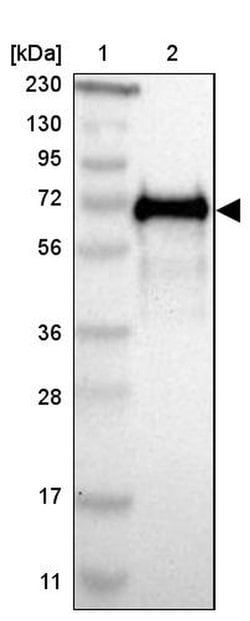
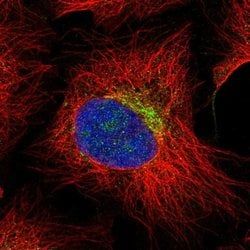
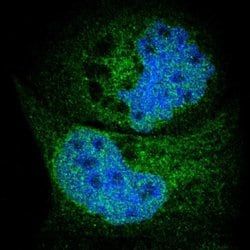
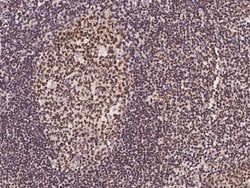
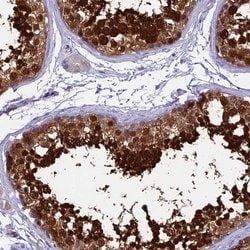
Immunocytochemistry, Immunohistochemistry (Paraffin), Western Blot
Concentration
1 mg/mL
Formulation
PBS with 50% glycerol and 0.02% sodium azide; pH 7.3
Gene Accession No.
O43719, Q8BGC0
Gene Symbols
Htatsf1
Immunogen
Recombinant protein of human HTATSF1.
Quantity
100 μL
Primary or Secondary
Primary
Target Species
Human, Mouse
Product Type
Antibody
Isotype
IgG
Related Products


Description
- The antibody was affinity-purified from rabbit antiserum by affinity-chromatography using epitope-specific immunogen and the purity is > 95% (by SDS-PAGE)
- The protein encoded by this gene functions as a cofactor for the stimulation of transcriptional elongation by HIV-1 Tat, which binds to the HIV-1 promoter through Tat-TAR interaction
- This protein may also serve as a dual-function factor to couple transcription and splicing and to facilitate their reciprocal activation
- Alternatively spliced transcript variants have been found for this gene.