Phospho-MST1/MST2 (Thr183, Thr180) Polyclonal Antibody, Invitrogen™
Manufacturer: Thermo Scientific
Select a Size
| Pack Size | SKU | Availability | Price |
|---|---|---|---|
| Each of 1 | PIPA578183-Each-of-1 | In Stock | ₹ 49,261.50 |
PIPA578183 - Each of 1
In Stock
Quantity
1
Base Price: ₹ 49,261.50
GST (18%): ₹ 8,867.07
Total Price: ₹ 58,128.57
Antigen
Phospho-MST1/MST2 (Thr183, Thr180)
Classification
Polyclonal
Conjugate
Unconjugated
Gene
Stk3
Gene Alias
0610042I06Rik; AI447339; AU020804; Kas-2; KB-1458E12.1; kinase responsive to stress 2; KRS1; KRS2; mammalian STE20-like protein kinase 1; Mammalian STE20-like protein kinase 2; mammalian sterile 20-like 1; mess1; MST; MST1; MST-1; MST1/C; MST1/C STK4; MST1/N; MST2; MST-2; MST2/C; MST2/N; Mst3; protein kinase homolog; serine/threonine kinase 3; serine/threonine kinase 3 (STE20 homolog, yeast); serine/threonine kinase 3 (Ste20, yeast homolog); serine/threonine kinase 4; serine/threonine-protein kinase 3; Serine/threonine-protein kinase 3 20kDa subunit; Serine/threonine-protein kinase 3 36kDa subunit; Serine/threonine-protein kinase 4; Serine/threonine-protein kinase 4 18kDa subunit; Serine/threonine-protein kinase 4 37kDa subunit; Serine/threonine-protein kinase Krs-1; serine/threonine-protein kinase Krs-2; Ste20; STE20-like kinase MST1; STE20-like kinase MST2; sterile 20-like kinase 1; STK3; Stk4; Yeast Sps1/Ste20-related kinase 3; YSK3
Host Species
Rabbit
Purification Method
Antigen affinity chromatography
Regulatory Status
RUO
Gene ID (Entrez)
6788, 6789
Content And Storage
Store at 4°C short term. For long term storage, store at -20°C, avoiding freeze/thaw cycles.
Form
Liquid
Applications
Western Blot
Concentration
1.54 mg/mL
Formulation
PBS with 1% BSA, 20% glycerol and 0.025% ProClin 300; pH 7
Gene Accession No.
Q13043, Q13188
Gene Symbols
Stk3, STK4
Immunogen
Carrier-protein conjugated synthetic peptide corresponding to residues around human MST1 (phospho Thr183)/MST2 (phospho Thr180).
Quantity
100 μL
Primary or Secondary
Primary
Target Species
Human
Product Type
Antibody
Isotype
IgG
Related Products



Description
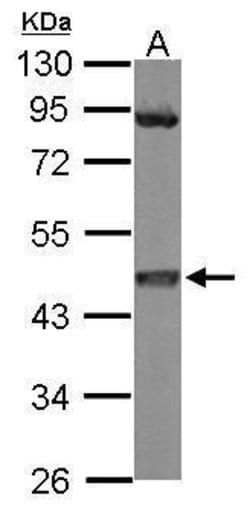
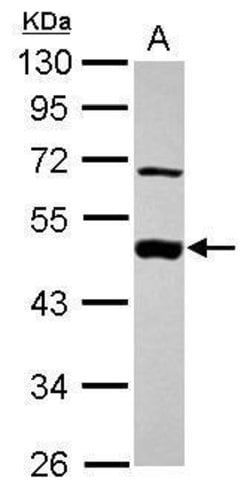
- Positive Control: HeLa (1 μM Staurosporine treatment for 3 hr) Predicted Reactivity: Mouse (100%), Rat (100%), Xenopus laevis (100%), Chicken (100%), Rhesus Monkey (100%), Chimpanzee (100%), Bovine (100%) Store product as a concentrated solution
- Centrifuge briefly prior to opening the vial
- STK3 and STK4 are stress-activated, pro-apoptotic kinases which, following caspase-cleavage, enters the nucleus and induces chromatin condensation followed by internucleosomal DNA fragmentation
- They are key components of the Hippo signaling pathway which plays a pivotal role in organ size control and tumor suppression by restricting proliferation and promoting apoptosis
- The core of this pathway is composed of a kinase cascade wherein STK3/MST2 and STK4/MST1, in complex with its regulatory protein SAV1, phosphorylates and activates LATS1/2 in complex with its regulatory protein MOB1, which in turn phosphorylates and inactivates YAP1 oncoprotein and WWTR1/TAZ
- Phosphorylation of YAP1 by LATS2 inhibits its translocation into the nucleus to regulate cellular genes important for cell proliferation, cell death, and cell migration
- STK3/MST2 and STK4/MST1 are required to repress proliferation of mature hepatocytes, to prevent activation of facultative adult liver stem cells (oval cells), and to inhibit tumor formation
- Phosphorylates NKX2-1
- Phosphorylates NEK2 and plays a role in centrosome disjunction by regulating the localization of NEK2 to centrosome, and its ability to phosphorylate CROCC and CEP250
- In conjunction with SAV1, activates the transcriptional activity of ESR1 through the modulation of its phosphorylation
- Positively regulates RAF1 activation via suppression of the inhibitory phosphorylation of RAF1 on 'Ser-259'
- Phosphorylates MOBKL1A and RASSF2
- Phosphorylates MOBKL1B on 'Thr-74'
- Acts cooperatively with MOBKL1B to activate STK38.