TRIM4 Polyclonal Antibody, Invitrogen™
Manufacturer: Thermo Scientific
Select a Size
| Pack Size | SKU | Availability | Price |
|---|---|---|---|
| Each of 1 | PIPA582676-Each-of-1 | In Stock | ₹ 48,905.50 |
PIPA582676 - Each of 1
In Stock
Quantity
1
Base Price: ₹ 48,905.50
GST (18%): ₹ 8,802.99
Total Price: ₹ 57,708.49
Antigen
TRIM4
Classification
Polyclonal
Conjugate
Unconjugated
Gene
TRIM4
Gene Alias
E3 ubiquitin-protein ligase TRIM4; RING finger protein 87; RING-type E3 ubiquitin transferase TRIM4; RNF87; TRIM4; tripartite motif containing 4; tripartite motif protein 4; tripartite motif-containing 4; Tripartite motif-containing protein 4
Host Species
Rabbit
Purification Method
Anitgen affinity chromatography, Antigen affinity chromatography
Regulatory Status
RUO
Gene ID (Entrez)
89122
Content And Storage
Store at 4°C short term. For long term storage, store at -20°C, avoiding freeze/thaw cycles.
Form
Liquid
Applications
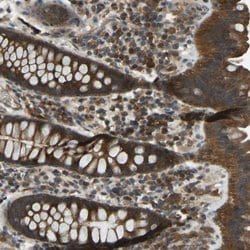
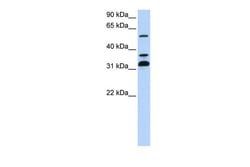
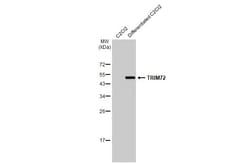
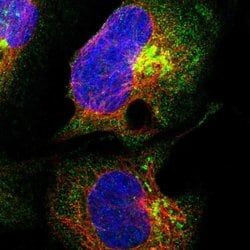
Immunocytochemistry, Immunohistochemistry
Concentration
0.2 mg/mL
Formulation
PBS with 40% glycerol and 0.02% sodium azide; pH 7.2
Gene Accession No.
Q9C037
Gene Symbols
TRIM4
Immunogen
Recombinant protein corresponding to Human TRIM4
Quantity
100 μL
Primary or Secondary
Primary
Target Species
Human
Product Type
Antibody
Isotype
IgG
Related Products




Description
- Immunogen sequence: KSQRNLVAKM KKVMHLQDVE VKNATQWKDK IKSQRMRIST EFSKLHNFLV EEEDLFLQRL NKEEEETKKK LNENTLKLNQ TIASLKKLIL EVGEKSQAPT LELLQNPK The protein encoded by this gene is a member of the tripartite motif (TRIM) family
- The TRIM motif includes three zinc-binding domains, a RING, a B-box type 1 and a B-box type 2, and a coiled-coil region
- The protein localizes to cytoplasmic bodies
- Its function has not been identified
- Alternative splicing of this gene generates two transcript variants.