HIPK4 Polyclonal Antibody, Invitrogen™
Manufacturer: Thermo Scientific
Select a Size
| Pack Size | SKU | Availability | Price |
|---|---|---|---|
| Each of 1 | PIPA582987-Each-of-1 | In Stock | ₹ 48,905.50 |
PIPA582987 - Each of 1
In Stock
Quantity
1
Base Price: ₹ 48,905.50
GST (18%): ₹ 8,802.99
Total Price: ₹ 57,708.49
Antigen
HIPK4
Classification
Polyclonal
Conjugate
Unconjugated
Gene
HIPK4
Gene Alias
Gm162; Hipk4; homeodomain interacting protein kinase 4; homeodomain-interacting protein kinase 4; LOW QUALITY PROTEIN: homeodomain-interacting protein kinase 4; testicular tissue protein Li 87
Host Species
Rabbit
Purification Method
Anitgen affinity chromatography, Antigen affinity chromatography
Regulatory Status
RUO
Gene ID (Entrez)
147746
Content And Storage
Store at 4°C short term. For long term storage, store at -20°C, avoiding freeze/thaw cycles.
Form
Liquid
Applications
Immunohistochemistry
Concentration
0.05 mg/mL
Formulation
PBS with 40% glycerol and 0.02% sodium azide; pH 7.2
Gene Accession No.
Q8NE63
Gene Symbols
HIPK4
Immunogen
Recombinant protein corresponding to Human HIPK4
Quantity
100 μL
Primary or Secondary
Primary
Target Species
Human
Product Type
Antibody
Isotype
IgG
Related Products
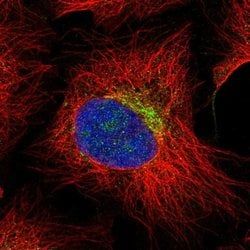


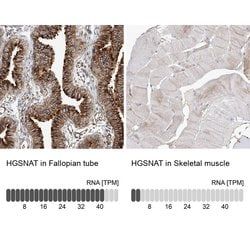
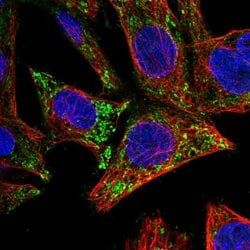


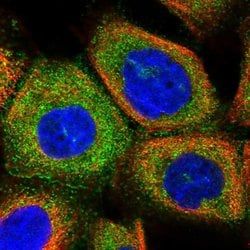
Description
- Immunogen sequence: SETDCYDIIE VLGKGTFGEV AKGWRRSTGE MVAIKILKND AYRNRIIKNE LKLLHCMRGL DPEEAHVIRF LEFFHDALKF YLVFELLEQN LFEFQKENNF APLPARHIRT VTLQVLTALA RLKELAIIH HIPK4 is a homeodomain-interacting protein kinase and has been demonstrated to phosphorylate p53
- HIPK4 encodes a member of the homeodomain interacting protein kinase (HIPK) family of proteins
- While other members of this family are found throughout vertebrates, this member is present only in mammals
- Compared to other members of this family, the encoded protein lacks a nuclear localization signal and a C-terminal autoinhibitory domain
- The encoded protein exhibits kinase activity and may phosphorylate the tumor suppressor protein p53.