AIFM3 Polyclonal Antibody, Invitrogen™
Manufacturer: Thermo Scientific
Select a Size
| Pack Size | SKU | Availability | Price |
|---|---|---|---|
| Each of 1 | PIPA599581-Each-of-1 | In Stock | ₹ 46,502.50 |
PIPA599581 - Each of 1
In Stock
Quantity
1
Base Price: ₹ 46,502.50
GST (18%): ₹ 8,370.45
Total Price: ₹ 54,872.95
Antigen
AIFM3
Classification
Polyclonal
Conjugate
Unconjugated
Gene
AIFM3
Gene Alias
2810401C16Rik; AI840249; Aifl; AIFM3; apoptosis inducing factor, mitochondria associated 3; apoptosis-inducing factor 3; apoptosis-inducing factor like; apoptosis-inducing factor, mitochondrion-associated 3; apoptosis-inducing factor, mitochondrion-associated, 3; apoptosis-inducing factor-like protein; RGD1306028
Host Species
Rabbit
Purification Method
Affinity chromatography
Regulatory Status
RUO
Gene ID (Entrez)
150209, 72168
Content And Storage
-20°C
Form
Liquid
Applications
Western Blot
Concentration
1 mg/mL
Formulation
PBS with 50% glycerol and 0.02% sodium azide; pH 7.4
Gene Accession No.
Q3TY86, Q96NN9
Gene Symbols
AIFM3
Immunogen
A synthesized peptide derived from human AIFM3(Accession Q96NN9), corresponding to amino acid residues P10-P60.
Quantity
100 μL
Primary or Secondary
Primary
Target Species
Human, Mouse
Product Type
Antibody
Isotype
IgG
Related Products




Description
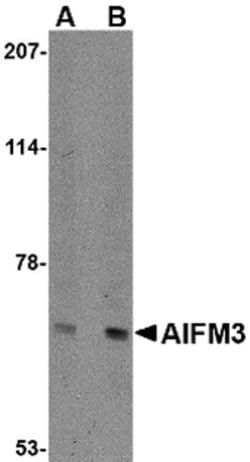
- Antibody detects endogenous levels of total AIFL
- Apoptosis, also known as programmed cell death, plays major roles in development and normal tissue turnover in addition to tumor formation
- Recently a protein similar to the apoptosis-inducing factor (AIF) was cloned and designated AIFL (also known as AIFM3)
- AIFM3 is expressed ubiquitously and is predominantly localized to the inner membranes of mitochondria
- Unlike AIF, AIFM3 does not translocate to the nucleus upon induction of apoptosis
- However, overexpression of AIFM3, like AIF, induced cytochrome c release from the mitochondria, cleavage of caspase 3, and μgtimately apoptosis, indicating AIFM3 induces apoptosis through caspase activation
- Multiple isoforms of AIFM3 are known to exist.