Sodium dodecyl sulfate
≥90% ((Assay))
Manufacturer: Sigma Aldrich
CAS Number: 151-21-3
Synonym(S): Dodecyl sodium sulfate, Dodecyl sulfate sodium salt, Lauryl sulfate sodium salt, SDS, Sodium lauryl sulfate
Select a Size
| Pack Size | SKU | Availability | Price |
|---|---|---|---|
| 1 KG | 62862-1-KG | In Stock | ₹ 9,103.83 |
62862 - 1 KG
In Stock
Quantity
1
Base Price: ₹ 9,103.83
GST (18%): ₹ 1,638.689
Total Price: ₹ 10,742.519
description
anionic 62
Quality Level
100
Assay
≥90% ((Assay))
mol wt
288.38 g/mol
technique(s)
LC/MS: suitableelectrophoresis: suitableprotein quantification: suitable
mp
204-207 °C (lit.)
solubility
water: soluble
HLB
40
SMILES string
[Na+].CCCCCCCCCCCCOS([O-])(=O)=O
InChI
1S/C12H26O4S.Na/c1-2-3-4-5-6-7-8-9-10-11-12-16-17(13,14)15;/h2-12H2,1H3,(H,13,14,15);/q;+1/p-1
Other Options
Related Products
Description
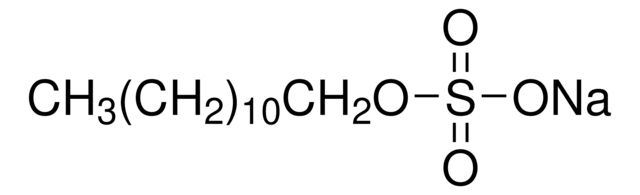
- General description: Sodium dodecyl sulfate (SDS), also known as sodium lauryl sulfate (SLS), has an alkyl tail of 12 carbon atoms attached to a sulfate group. It is an anionic surfactant due to the negative charge of its sulfate group.[1]
- Application: Sodium dodecyl sulfate has been used:to prepare Chit for coating the Janus micromotors for the synthesis of magnesium (Mg)-based micromotors[2]as a component in low salt lysis buffer to lyse the edible bird’s nest (EBN) treated cells for western blot analysis[3]in the preparation of decellularizing solution to scale down and decellularize skin fragments[4]
- Biochem/physiol Actions: Sodium dodecyl sulfate (SDS) is frequently used as an ingredient in a wide range of products, including pharmaceuticals, and product formulations. It is broadly used in several applications including electrophoresis for the separation of proteins and as an organic template for preparing periodic mesoporous organosilica nanospheres. SDS is also used in the solubilization of proteins and lipids, as well as drugs, dispersion of functionalized carbon nanotubes and graphene sheets, and gas hydrate formation.[1] It is commonly used for the quick disruption of biological membranes. Due to its ability to disrupt the tissue architecture, SDS is preferred in several nucleic acid purification reagents. SDS has very low solubility in high salt, and chaotropic solutions and is readily precipitable in the presence of potassium salts, so it is usually not added to guanidinium buffers.[5]
- Features and Benefits: Assay: ≥90%Suitable for LC/MS, electrophoresis, and protein quantification Inhibits RNase and deoxyribonuclease (DNase) activity[5]
SAFETY INFORMATION
Pictograms
Signal Word
Danger
Hazard Statements
Precautionary Statements
P210 - P273 - P280 - P301 + P312 - P304 + P340 + P312 - P305 + P351 + P338
Hazard Classifications
Acute Tox. 4 Inhalation - Acute Tox. 4 Oral - Aquatic Chronic 3 - Eye Dam. 1 - Flam. Sol. 2 - Skin Irrit. 2 - STOT SE 3
Target Organs
Respiratory system
WGK
WGK 2
Personal Protective Equipment
dust mask type N95 (US), Eyeshields, Gloves