L3771
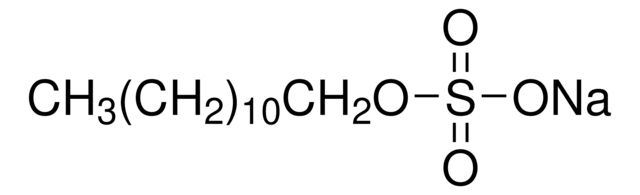
Sodium dodecyl sulfate
Manufacturer: Sigma Aldrich
CAS Number: 151-21-3
Synonym(S): Dodecyl sodium sulfate, Dodecyl sulfate sodium salt, Lauryl sulfate sodium salt, SDS, Sodium lauryl sulfate
Select a Size
| Pack Size | SKU | Availability | Price |
|---|---|---|---|
| 25 G | L3771-25-G | In Stock | ₹ 6,350.00 |
| 100 G | L3771-100-G | In Stock | ₹ 12,660.00 |
| 500 G | L3771-500-G | In Stock | ₹ 20,210.00 |
| 1 KG | L3771-1-KG | In Stock | ₹ 29,900.00 |
| 10 KG | L3771-10-KG | In Stock | ₹ 2,29,197.73 |
L3771 - 25 G
In Stock
Quantity
1
Base Price: ₹ 6,350.00
GST (18%): ₹ 1,143.00
Total Price: ₹ 7,493.00
biological source
synthetic
Quality Level
200
grade
for molecular biology
description
anionic
product line
BioReagent
Assay
≥98.5% (GC)
form
powder
mol wt
micellar 18,000
aggregation number
62
technique(s)
electrophoresis: suitable
Other Options
...
Related Products
Description
- General description: Sodium dodecyl sulfate (SDS), also known as sodium lauryl sulfate, is an anionic surfactant widely used in various scientific applications, particularly in molecular biology, biochemical, and cell biology research. Its effectiveness stems from its amphiphilic nature, allowing it to interact with both hydrophobic and hydrophilic molecules. SDS is a versatile detergent that excels in solubilizing and denaturing proteins, making it an essential tool in protein extraction and purification procedures. By disrupting protein structures, SDS facilitates the separation of proteins based on their molecular weight during SDS-PAGE electrophoresis.Beyond protein analysis, SDS also finds applications in the electrophoretic separation of lipids, enabling the study and characterization of these important cellular components. Additionally, SDS is employed in various hybridization and molecular biology techniques, demonstrating its versatility across a range of research areas. SDS′s effectiveness in both ionic and anionic conditions further expands its utility, allowing it to adapt to diverse experimental setups and requirements. Its ability to unravel proteins by binding to peptide chains and imparting a negative charge effectively eliminates protein shape as a factor for gel separation, ensuring accurate protein size determination.
- Application: Sodium dodecyl sulfate has been used:in chromatin immunoprecipitationin SDS-polyacrylamide gel electrophoresis (SDS-PAGE)as a component of radioimmunoprecipitation assay buffer for immunoblotting
- Features and Benefits: Highly versatile surfactant for your molecular biology and biochemical researchSuitable for electrophoresis applicationsTested to confirm low levels of heavy metal contamination,ensuring suitability for various applications.
- Analysis Note: Tested for use in denatured polyacrylamide gel electrophoresis.
- Other Notes: 2024 CiteAb Award Winner for Supplier Succeeding in Parkinson′s Research
SAFETY INFORMATION
Pictograms
Signal Word
Danger
Hazard Statements
Precautionary Statements
P210 - P273 - P280 - P301 + P312 - P304 + P340 + P312 - P305 + P351 + P338
Hazard Classifications
Acute Tox. 4 Inhalation - Acute Tox. 4 Oral - Aquatic Chronic 3 - Eye Dam. 1 - Flam. Sol. 2 - Skin Irrit. 2 - STOT SE 3
Target Organs
Respiratory system
WGK
WGK 2
Flash Point(F)
338.0 °F
Flash Point(C)
170 °C
Personal Protective Equipment
dust mask type N95 (US), Eyeshields, Gloves